For many Western news outlets, the success of Lee Sang-il’s 2025 film Kokuho (国宝, National Treasure), adapting Shuichi Yoshida’s novel of the same name, came as quite a shock. After all, the fact that a 3-hour-long film, in the current media landscape, could become the highest-grossing domestic Japanese live-action film of all time, made for a striking story. But while this is remarkable, it’s not necessarily surprising. You see, Kokuho is one of those rare films that was uniquely positioned to become an instant Japanese classic. This is something supported by its incredible run in the Japanese Academy Awards, where it won 10 awards, including best film, actor, and director. There are many reasons for this critical and commercial success, but one we found particularly important is its treatment of kabuki (歌舞伎).
Kokuho’s approach to kabuki is one that communicates something beyond respect for it. In many ways, it is a love letter to the art form, but also a confession of the overpowering (and terrifying) feelings that come with said love. It’s a nuanced perspective that transforms kabuki (and the world that surrounds it) into the driving force of the film’s narrative and thematic depth.
At its heart, the film is an ode to kabuki. To fully understand it, we have to look at the tradition it honours and how it reimagines it for the silver screen.
The Story of Kokuho

Kokuho follows the fifty-year-long-career of Kikuo Tachibana (played by Ryo Yoshizawa, 吉沢 亮), an Onnagata (male actor that performs female roles) that begins practicing kabuki in 1964 and is recognized as a master by 2014. What makes Kikuo special (besides his obvious talent and passion) is the fact that he is the son of a Yakuza. His tattooed back is a constant reminder, for both the characters and the audience, that Kikuo is an outsider trying to be accepted in a field dominated by bloodlines. It is the tale of two intertwining legacies, one dominated by violence and the other by beautiful performances. Kikuo is, consequently, desperately trying to re-write one for the other.
The film is officially set in motion when renowned kabuki actor Hanai Hanjiro II (played by Ken Watanabe, 渡辺 謙) sees Kikuo act and decides to take him under his wing. He becomes a sort of adopted son to him, and thus forms a brother-like bond with Hanjiro’s son, Shunsuke (Ryusei Yokohama, 横浜 流星). As the film progresses, both Kikuo and Shunsuke become Onnagata, and their relationship creates the emotional core of the film. On one hand, Kokuho frames Kikuo as the more talented one, which makes Shunsuke insecure about his acting abilities; on the other, Shunsuke is the rightful heir, and Kikuo’s past as the son of a Yakuza makes it increasingly hard for him to navigate the world that surrounds Kabuki.
Since the film is mostly focused on Kikuo, his increasingly self-destructive ambition to prove himself takes over the narrative. Conflict inevitably arises, and the way that clashes with his relationship with Shunsuke and the larger Kabuki world, is definitely something you should experience for yourself.
Kabuki and its Traditions

Kabuki is a classical Japanese theatre form that originated in Kyoto during the early Edo Period (17th century). It mixes stylised acting, dance, and music, performed by male actors in elaborate costumes and distinctive makeup, with stories that often explore dramatic themes of history, love, and moral conflict. While it might be tempting to compare it with early forms of Western theatre like Spanish Zarzuelas (or even contemporary musicals), Kabuki stands out for its execution, combining brash moments with quiet peaks of intensity. This is best exemplified in the technique of Mie (見得): a powerful pose actors use to freeze the moment and amplify tensions. Kabuki, alongside other classical Japanese art forms such as Bunraku and Noh, is recognized by UNESCO as Intangible Cultural Heritage of Humanity.
The narrative structure of Kabuki plays, known as Jo-ha-kyū (序破急), follows a slow set-up, rapid development, and an abrupt, disquieting ending. Curiously, this is a structure it shares with Noh. The subjects tackled in Kabuki plays, however, are quite different from those found in this other classical Japanese art form. While Noh often stays in the realm of the spiritual and the timeless, Kabuki dives into human drama, history, love, loss, and moral conflict. As such, most Kabuki plays fall under three different categories: historical epics (時代物, jidaimono), domestic dramas (世話物, sewamono), and dance-heavy pieces (所作事, shosagoto).
Relevant for our discussion on Kokuho is that kabuki doesn’t, and has never, existed in a vacuum. Japanese society regards kabuki very highly and has always influenced who could participate in it. Inheritance, for example, is very important in kabuki, and one is more likely to be considered if they come from a dynastic family of actors. However, perhaps the most shocking example for Western audiences has to do with the existence of the Onnagata.
The Onnagata
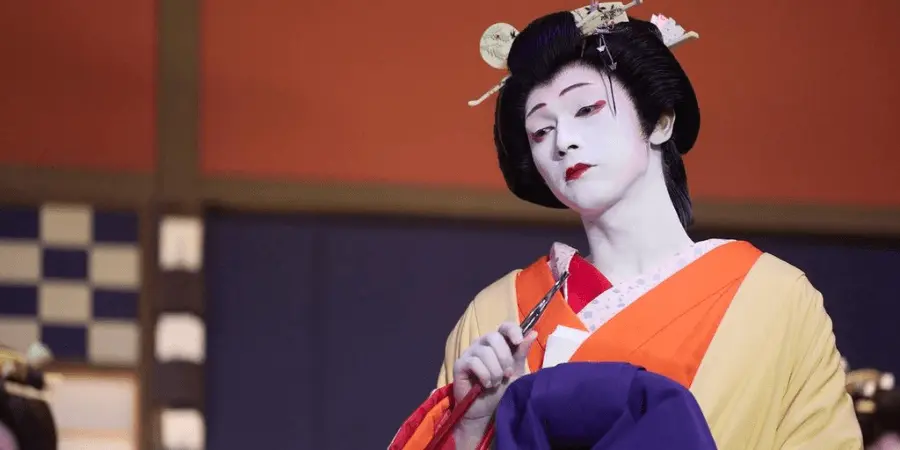
Kabuki, at least in the biggest and most important theaters, is famously a men’s only profession, with female roles played by male actors known as Onnagata. The origins of this can be traced back to the Edo Period, when the Tokugawa Shogunate prohibited women from participating in kabuki. As a matter of fact, historical records indicate that Kabuki was created by women, with Izumo no Okuni (出雲 阿国) commonly regarded as the originator of the art form. In any case, the Shogunate, as Kokuho’s opening credits accurately state, banned women from participating in 1629, fearing a “moral decline.”
If you’re familiar with Western theatre history, especially Elizabethan theatre (plays by William Shakespeare), you’ll know this isn’t anything new. Women in the Elizabethan and Jacobean eras were also banned from performing on stage for very similar “moral” reasons: acting was considered indecent for a woman. However, they were eventually allowed back on stage in the West, and while all-female Kabuki troupes have existed since the Meiji Era (when the ban was officially lifted), Japan has maintained mainstream Kabuki as a men’s only field.
Why Kabuki Is Still a Men-Only Art?

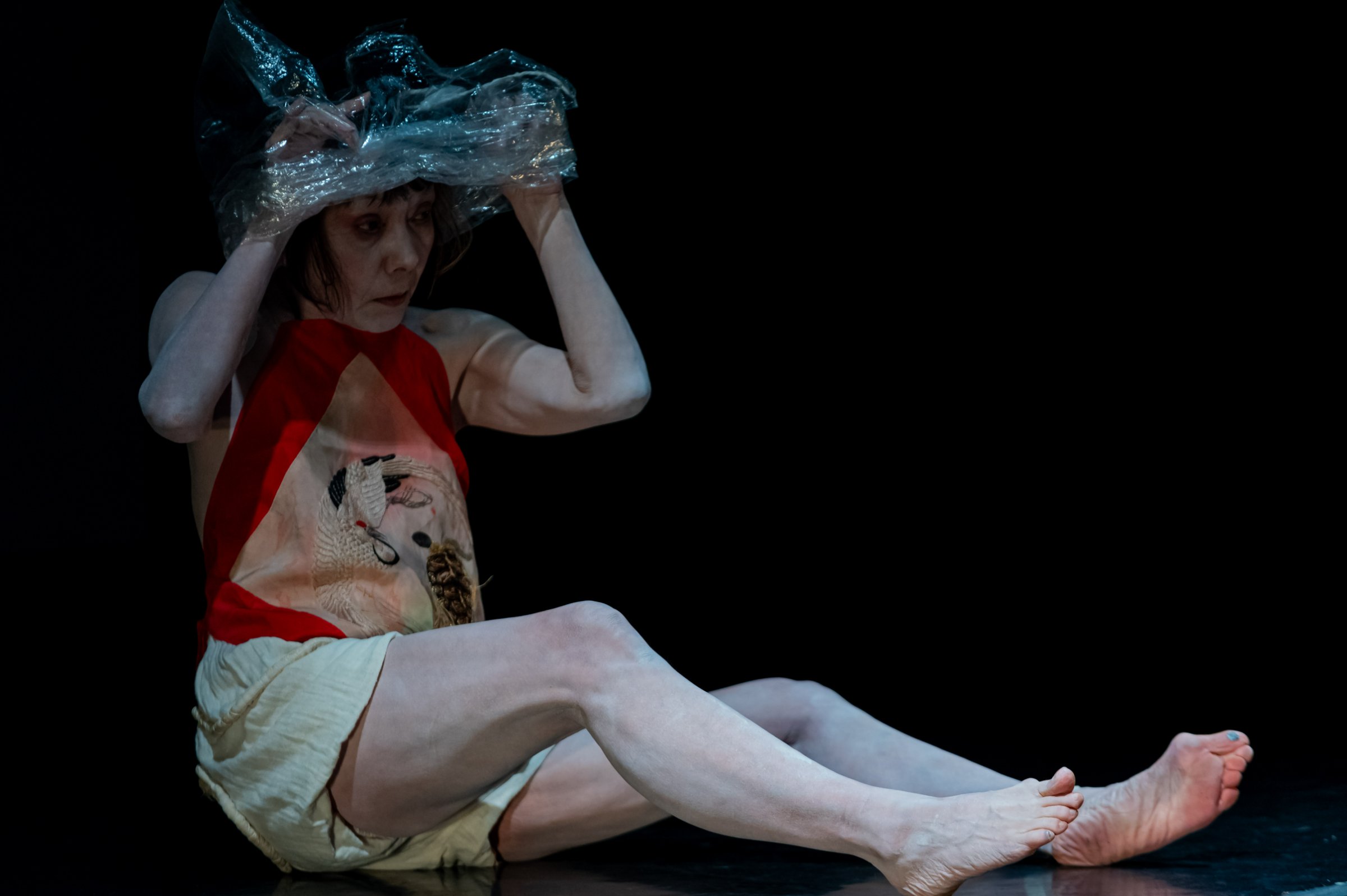
As the art form evolved, the role of Onnagata developed a distinct identity that became inseparable from Kabuki. It is, to put it plainly, a gender performance where the goal is to master techniques (voice modulation, gestures and poses), creating an idealized feminine figure. They aspire towards femininity, not womanhood. So, under the specific environment fostered by Kabuki theatre, the Onnagata put on their makeup and theatrically perform a completely unique version of femininity. And that gender-defying act of mastery became a part of the Onnagata and, in turn, Kabuki’s appeal.

Kokuho, an Homage to Kabuki
Now that we understand what kabuki is, how its structure, and the forces that have shaped (and continue to shape) it, we can finally look at Kokuho.
The film, from the very beginning, makes an effort to convey that kabuki is not merely a decorative piece nor a simple plot device. Kabuki, in its totality, takes center stage in the film’s narrative. Moreover, the film borrows themes from kabuki plays and then uses those same plays to draw parallels, making its point resonate more, which is especially effective with a Japanese audience already familiar with them.
In short, the film takes the bold approach of wearing its influences very visibly. And what’s truly remarkable is that this doesn’t make the movie derivative or predictable, but engaged in a continuous dialogue with the artform. It is a deliberate attempt to tell a story about, and in conversation with, kabuki.
The Structure of Kokuho

Kokuho’s structure stands out as one of the most uniquely realised and ambitious of the last few years. As mentioned earlier, the narrative expands over fifty years, and is capable of doing so by dividing itself into nine sequences set in different time periods. If you’re a film scholar, this already sounds promising, as is taking an approach similar to that of Paul Joseph Gulino’s “Sequence Approach,” aiming to make each segment of the film have its own identity.
However, Kokuho doesn’t stop there. In line with its homage to kabuki, the film can also be approached through the lens of Jo-ha-kyū. We begin with a slow introduction to the characters, their motivations, grievances and obstacles to overcome. Then, these characters are thrown into the world of Kabuki and all the problems that seemed distant rapidly come forth, bringing the best (and worst) of them. By the end, when things have calmed down, what remains is a quiet, satisfying but also open and heartfelt ending that is perfectly in line with Kabuki tradition.
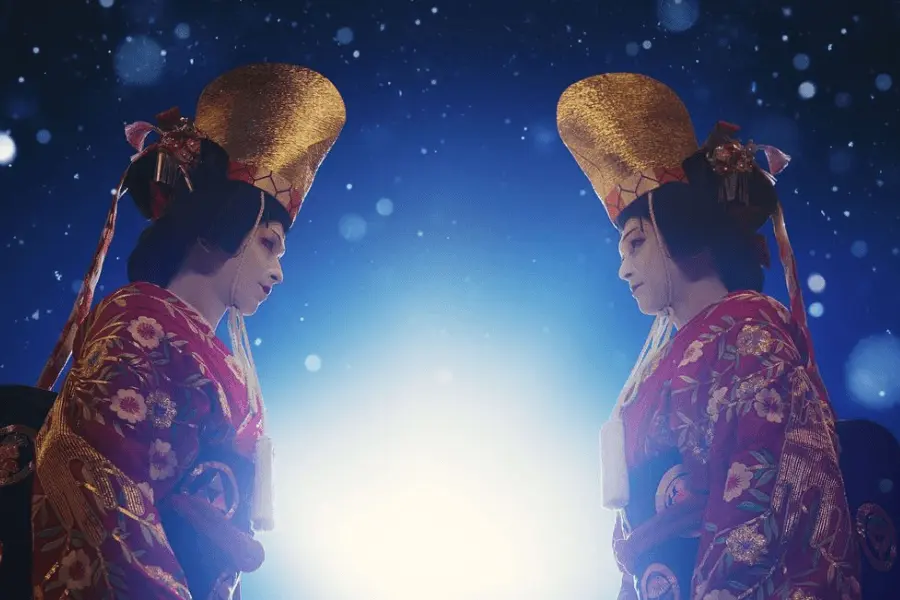
Finally, one structural choice that stands out is its incorporation of Kabuki plays. Text with a brief plot summary of plays like The Snowbound Barrier (積恋雪関扉), Two Lions (連獅子), The Heron Maiden (鷺娘), and more, are shown as the characters perform them. This is especially prominent in the first half of the film, as a young Kikuo and Shunsuke start developing their personalities in relation to these plays. By the second half, they have already internalized them and the text explaining them only returns in the very end. To put it simply, it’s an incredibly effective set-up and payoff that grounds our understanding of the characters in the timeline the film has created.
Translating Kabuki’s Appeal to film

There’s a scene around one-third into the film where Kikuo unequivocally falls in love with Kabuki. Without getting into spoilers, what you need to know is that Kokuho shows the audience an intentionally blurry image. It’s a glimpse whose vagueness is immediately associated with the feeling of loving something and not finding the words to describe it. This is movie magic in its purest form, using the audio-visual language to express something poets found in metaphors and musicians in arpeggios.
And this scene is but one example. Kokuho is a visually stunning film that uses every element of filmmaking at its disposal to convey the filmmaker’s appreciation for kabuki. If you’re a Kabuki enthusiast, you’ll find something to love in the film’s presentation; if you’re unfamiliar with the artform, the artistic direction will make you care about it. Everything from acting performances to editing and sound design is in service of portraying Kabuki with an honest light.
To better grasp this, let’s look at some concrete examples.
Cast performances

Perhaps the most noticeable thing about the portrayal of Kabuki plays in the film is how immediately engaging they are. Kikuo and Shunsuke’s performances as Onnagata is completely different from their regular acting, with subtle and rhythmic movements backdropped by a high pitched voice that exudes femininity. One particularly illustrative scene of this is when Kikuo is performing The Love Suicides at Sonezaki (曾根崎心中), and every moment of tension is delivered with a lunge-like burst of emotions that is guaranteed to capture the viewers’ attention. It gets to a point where one can’t help but wonder if it’s all an artifice. And the answer is no.
Actors Ryo Yoshizawa and Ryusei Yokohama spent a year and a half training under Kabuki master Nakamura Ganjirō IV (四代目 中村 鴈治郎). The performances are so believable precisely because they learned to sustain a form that requires strict physical training. While Yoshizawa has gone on record saying a year and a half is not remotely comparable to a timeline of experience, it did help him realise what he needed to do. He and Yokohama, possibly in a humbling way, discovered what it really meant to do Kabuki. And it’s precisely this realization that they bring to their performances as Kikuo and Shunsuke.
Cinematography and editing
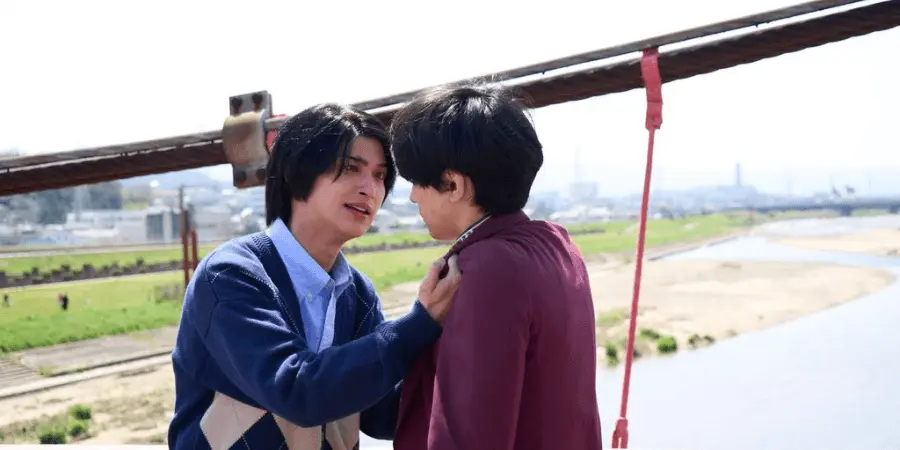
There’s no simpler way to say this: the film is gorgeous. Each shot in Kokuho was meticulously calculated to convey as much meaning as possible, often playing with the environment to reflect the characters’ inner turmoils. To use an example, there’s a scene where Kikuo and Shunsuke are discussing on a bridge, and when it becomes clear they have unresolved business, the camera pans out and their emotional distance becomes tangible.
Of course, this smart use of cinematography and editing is brilliantly translated to Kokuho’s portrayal of kabuki. Here, close-up shots are used masterfully as we get close to the actors’ faces, the intimate ritual of applying makeup, and their subtle and seductive hand gestures. The key word here is physicality, as some of the best shots are of the lingering poses of Mie, with one particularly brilliant one emphasizing the shoulder blades’ attempt to touch each other.
The overarching point, which the editing and composition help to convey, is that Kabuki is as beautiful as it is physically and mentally demanding.
Soundtrack and Sound Design
Ambient musician Marihiko Hara (原 摩利彦) was brought to compose the soundtrack of the film, and the end result is nothing short of extraordinary. His expertise in ambience gives the film a constant allure of mystique that makes even the most trivial moments engaging. But this isn’t to say the soundtrack is an ambient one, far from it. The most common elements are strings and piano keys, whose exuberant presence is meant to draw parallels with Kabuki. Many of the songs, in fact, intentionally resemble the structure of jo-ha-kyū: a quiet ambient-like beginning, a loud arpeggio reaching a peak of intensity, and a slow almost still conclusion. For a great example of this, listen to the title-track, Kokuho.
When it comes to the Kabuki plays themselves, Marihiko’s soundtrack is replaced with a typical live shamisen and drum performances. While these are fascinating on their own, the film’s true merit lies in the sound design by Mitsugu Shiratori (白取 貢). The accelerating beats of the drums and the rising tension conveyed by the shamisen is perfectly captured by the mixing, bringing us just close enough so that we feel their power. Strings shake in our ears, drums reverberate and the friction of kimonos against the stage’s floor is palpable.
Moreover, theatre props are given their time to shine. A great example is in a scene when Kikuo is preparing to perform and slowly opens a fan. Here, we can hear how the paper of each segment unfolds, with the result being a slowburning tension where a great performance is promised (and, eventually, delivered).
Makeup

Finally, the last element of the film we’ll be discussing is perhaps the most noticeable one: the makeup. As a matter of fact, Kokuho was nominated to the 2026 Academy Awards under the category of Best Makeup and Hairstyling. And with a quick glance at the film, it is easy to see why. Makeup artists Kyoko Toyokawa (豊川 京子), Naomi Hibino (日比野 菜緒美) and Tadashi Nishimatsu (西松 正) really did a fantastic job capturing the extravagant costumes of Kabuki, as well as the sophisticated attires of the world that surrounds it. There’s an immediate contrast between these worlds that is communicated very subtly through makeup, as if characters, whether acting or not, were forced to play into a role.
While contrast is very important in Kokuho, the truth is the makeup and costumes stand out on their own. The filmmakers clearly wanted to convey the high production value of mainstream Kabuki, which is why the costumes are not merely cheap imitation: the wigs, sandals and kimonos were carefully selected to appease even the most die-hard kabuki enthusiast. And, in the process of doing so, they created an image so visually appealing even non-kabuki fans will find something to appreciate.
Where Kokuho falls short

Kokuho isn’t the first time director Lee Sang-il has adapted a Shuichi Yoshida novel. As a matter of fact, it’s the third time he has done it, coming after 2010’s Villain (悪人) and 2016’s Rage (怒り). Both of these previous adaptations were critical and commercial successes in Japan’s domestic box office, and judging by the production value of Kokuho, it’s safe to say Lee was given a lot of creative and financial freedom. This, ironically, is where many of the film’s shortcomings arise.
You see, Lee Sang-il had a very ambitious vision for Kokuho, one that promised to be a faithful adaptation of an 800-page-long novel. Quite understandably, all of that couldn’t fit in the standard theatrical runtime, so a lengthy film was to be expected. However, the initial cut of the film ended up at four and a half hours, way too long for theatrical release. According to an interview with Lee Sang-il, he had to cut it down to three hours and that process was incredibly difficult.
These production problems are ones that, I’d argue, do translate to the finished product. Kokuho is definitely a cohesive film, and the three hours that we got are undoubtedly the best three hours of footage. However, while plot lines are not abandoned, some of them are rushed or underdeveloped (some secondary characters’ inclusion, for example, feels unnecessary), and the film’s emotional impact can suffer because of this.
This isn’t to say the film is not worth watching, far from it. It’s a fascinating film and definitely retains Lee’s vision of what an adaptation of Kokuho should look like. Hopefully, the film’s success will lead to the release of the original cut, and that is something I’m personally looking forward to.

Should you watch Kokuho before a Kabuki show

Having discussed Kokuho at length, one question remains unanswered: who is the target audience? Is it Kabuki enthusiasts or people who are unfamiliar with the art form? Who will get the most enjoyment out of it? The answer, dear reader, is that it is both.
Kokuho is a masterfully crafted film that, if you’re a fan of Kabuki, will come across as an endearing and heartfelt representation; and if you’re not, the film will guide you through that world and make you, at the very least, understand its appeal. So to the question, should you watch Kokuho before a Kabuki show? It depends. You’ll definitely get more enjoyment if you’re already familiar with the plays the film is discussing, similar to music fans watching a well-made biopic. But on the other hand, if kabuki is something that interests you but you’re unsure where to start, Kokuho provides a path to the greatest hits of the medium. Moreover, its three-hour-runtime is actually a great preparation for the length of a normal Kabuki play.
What is hard to argue against is that the filmmakers of Kokuho love kabuki. A love that is as sincere as it is contagious. A love that fans will immediately recognize and outsiders will seek to comprehend.
Last Words

Let’s end this article the same way it began: Kokuho smashed domestic box-office records and became Japan’s highest-grossing live-action film of all time. This is not surprising. Kokuho is an amazingly directed, acted, composed and edited film that uses a classical Japanese art form as the basis for its narrative cohesion and thematic depth. So no, it is not surprising that Japanese audiences gravitated towards a film that is both able to honour one of their most respected traditions and create an engaging modern story. With an ambitious scope, a culturally relevant theme and the production assets to realise its vision, Kokuho was destined to become an instant Japanese classic.
Having won 10 Japanese Academy Awards, Kokuho currently sits as the fourth most decorated film of the ceremony’s history. It has, in turn, entered a conversation with films like Shall We Dance? (1996) and The Twilight Samurai (たそがれ清兵衛, 2002). And this was achieved in no small part because of kabuki and Kokuho’s unflinching willingness to portray it in an engaging and sincere way. So whether you’re a Kabuki enthusiast, a Japanese cinema fan, or someone wondering what all the fuss is about, don’t lose your chance to watch this wonderful film.