In a previous piece, we discussed Fyodor Dostoevsky’s influence on Japan, exploring how the Russian author was received as a roadmap for understanding the modern psyche. As Japan developed within the modern world, this reception left an imprint on the subsequent production of Japanese fiction. Some standout examples can be found in the works of writers such as Osamu Dazai (太宰 治), Ryunosuke Akutagawa (芥川 龍之介), and Oda Sakunosuke (織田 作之助). However, if you read the article, a noticeable piece of art was missing, one that might strike some readers as an obvious inclusion: Akira Kurosawa’s The Idiot (白痴).
Indeed, what could better demonstrate Dostoevsky’s influence than a Japanese adaptation of one of his most famous novels? One made by one of Japan’s most revered directors? And yet, we left it out because we believed Kurosawa’s The Idiot deserves its own article. The film, it turns out, is a fascinating example of an author not merely adapting someone else’s work, but making it his. The Idiot, for as faithful an adaptation as it is, nevertheless makes changes that make it specifically Kurosawa’s version of the story.
To understand this, we need to look at Dostoevsky’s The Idiot, the changes Kurosawa made and even why he addresses the Russian author directly within the film.
Dostoevsky’s The Idiot and Why a Change Was Necessary
Out of all of Dostoevsky’s work, The Idiot is perhaps the one with the most fascinating author–novel relationship. After writing it, Dostoevsky didn’t feel regret, nor excitement, nor surprise, but bittersweet acceptance. In a letter to his friend and literary critic, Nikolay Strakhov, he stated: “I do not stand behind the novel, but I do stand behind the idea.” So it begs the question: what idea was that?
The novel’s premise is as simple as it is effective: a character so profoundly good that everyone mistakes him for an idiot. Out of this, Dostoevsky crafts a story that speaks to what he saw as Russian society’s moral pitfalls. The main character, Lev Nikolayevich Myshkin (the “idiot”), is thrown into a troublesome and dangerous love triangle in which his goodness is seen as salvation, but also the prelude to his own demise. It’s a story where Dostoevsky personified what he saw as the pinnacle of goodness: Christian love. This moral ideal is, somehow, portrayed as insufficient in modern times, not for being a flawed ideology, but for existing in a fundamentally flawed society.
The novel, however, was published serially in the journal The Russian Messenger between 1868 and 1869, and sadly inherited many of the flaws associated with this type of release schedule. Plot points were abandoned, secondary characters played insubstantial roles, and the flow of it all was sluggish. Moreover, Dostoevsky was experimenting with the novel, as he was constantly testing himself on how to write a character who perfectly embodied the Christian soul.
Nevertheless, The Idiot was quickly recognized as another Dostoevsky masterpiece. It’s a chaotic work of fiction that, despite its shortcomings, manages to strike a universal human chord. However, if there ever was a Dostoevsky novel rough around the edges, it was The Idiot. An adaptation, in this sense, becomes a rare opportunity to address the flaws that were, even by Dostoevsky’s own admission, built into the novel. Kurosawa could have simply corrected those rough edges, but he wanted to go further with the story. He wanted to make his own version of it.
Akira Kurosawa and the Art of Adaptations

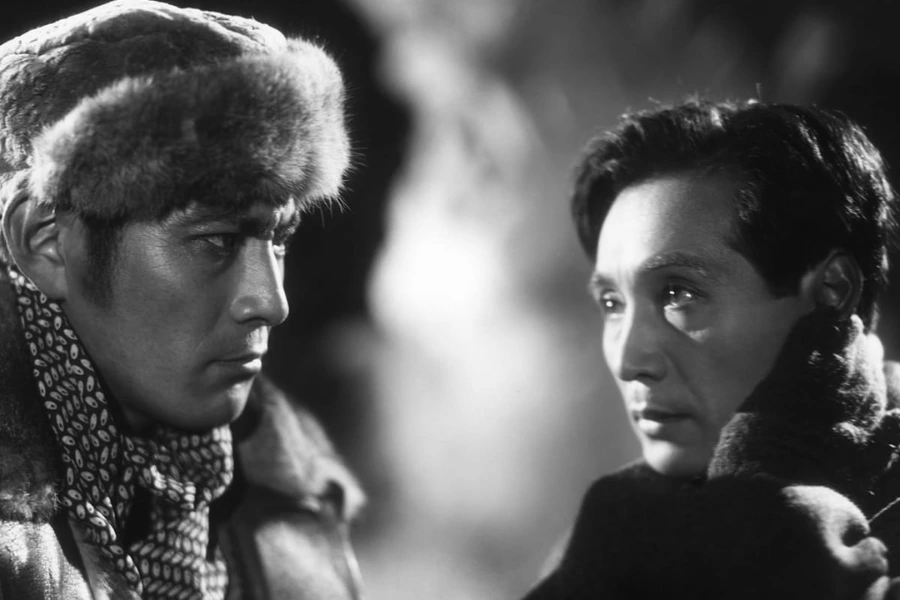
Kameda, Takeo and Akama in the Hokkaido snow.
Akira Kurosawa (黒澤 明) is no stranger to cinematic adaptations. While an excellent writer on his own, being credited with original scripts like Seven Samurai (七人の侍) and Yojimbo (用心棒), some of his most celebrated works have been adaptations. Shakespeare, for example, was of notable interest to Kurosawa, as he adapted his plays into films such as Throne of Blood (蜘蛛巣城, Macbeth), The Bad Sleep Well (悪い奴ほどよく眠る, Hamlet), and Ran (乱, King Lear).
It’s true that in all of these films Kurosawa has added his own distinct spin, with dialogue, setting and characters that matched the filmmaker’s preferred style. However, few of his adaptations were as overt in their intentions as The Idiot. According to Kurosawa, he wanted to make it for a long time, as he considers Dostoevsky the writer who wrote the most honestly about human existence. In the first minutes of the film, we even see Kurosawa directly mentioning Dostoevsky with on-screen text, declaring how interesting it is that he chose an idiot to be the embodiment of goodness.
From the outset, Kurosawa was creating some distance between him and Dostoevsky, as if to show his intention with the film was not to translate him, but to comprehend him. This is further supported when we look at the production. Much like the novel, the film was an experimental endeavour: originally 265 minutes long and nearly completely faithful to the book. We could even say painfully faithful, as the first screening was poorly received by audience members, prompting the studio to cut it down to the currently existing version, around 160 minutes long.
While rejected at first, the cut film was eventually approved by Kurosawa, and in many ways it shows his intentions in creating a version of the story that was unmistakably his own. Dostoevsky’s novel became a blueprint, or perhaps an outline, Kurosawa could use to directly address things he personally cared about. But to understand that more clearly, we need to look at what exactly he changed.

Akira Kurosawa’s The Idiot

Ayako covers Kameda’s mouth because he is talking about Taeko.
Kurosawa’s The Idiot immediately makes its changes clear from the setting alone, as we go from the aristocratic nineteenth-century Russia to the ravaged landscape of postwar Japan. While it is true that Kurosawa uses Hokkaido to mimic Russia’s oppressive winter, the World War II background is essential for his version of the story. Wealth, for example, plays a much different role in the film. Rather than a barrier of entry into aristocratic society, the same one the Russian author aimed to critique, wealth is seen as a luxury that allows a small group of people to live what were, before the war, normal lives. The war is, therefore, framed as an event that physically and psychologically scarred Japan, bringing out some of its ugliest characteristics.
The main character, Kameda, is not so much a personification of Christian love as a figure for the goodness Japan could embody if they’d learn the right lessons from the war. He is a fragile individual who suffers from post-traumatic stress, especially haunted by the fact he was about to be executed as a war criminal. While presented as naive, the film is constantly reminding us that this experience made him, above all, an honest man.
If the other character approached the turmoils of postwar Japan with Kameda’s honesty, much of the film’s conflict would be resolved. However, not everyone is as good as he is, even when they desperately want to be.
The Characters
The other characters in the story are meant to represent different attitudes shaped by the hostile environment of postwar Japan.
A great example is the character of Akama, played by legendary actor Toshiro Mifune (三船 敏郎). He is a self-described “thug” and believes his problems can be resolved by either violence or wealth. Nevertheless, the character is not two-dimensional, showing sides of goodness that make him endearing. The film constantly invites the audience to root for him to take the path Kameda has laid out for him, which makes it all the more heartbreaking when he leans towards his most destructive tendencies.
On the other hand, we have Taeko, played by renowned actress Setsuko Hara (原 節子), who doesn’t believe herself to be worthy of happiness to begin with. She is presented as a beautiful woman with a tragic past, bought by a rich man who constantly abused her sexually, and profited by offering her to others as well. Rather than a victim, the rebuilding Japan, keen on establishing some sense of honour, sees her as an embarrassment to be pushed aside. This, crucially, is something Taeko internalized. Kameda is the only character to treat her for what she is, but, scared of affection, she runs away hoping that Kameda alone will find happiness.
Finally, there’s Ayako, played by Yoshiko Kuga (久我 美子). She is, in one sentence, everything that Taeko wishes to be: a young, innocent and composed lady who lives according to Japan’s postwar ideals. Nevertheless, Ayako is an indecisive girl, and is profoundly afraid that Kameda has more sympathy for Taeko than love for her. When faced with genuine compassion, her postwar idealism clouds her judgment and makes her run away. In the end, she believes herself to be a bigger idiot than Kameda, precisely because she doubted the sincerity of his feelings.
These characters show how far Kurosawa has moved from a simple translation of the novel’s plot. The next step is to look at how he uses the language of film to make this version of The Idiot unmistakably his.
The Idiot’s Use of Cinematic Language
Kurosawa is an expert in the psychological use of cinematic language, and The Idiot is a striking example of that expertise. Framing, composition and editing are used superbly to show the characters’ inner turmoil, particularly through their faces. One great example is when Kameda sees Taeko’s face for the first time. In this scene, Kameda and Akama are looking at a picture of her in the poster which offers a 600,000 yen reward to whoever marries her. The camera is positioned behind them while we see their reflection in a mirror. The worried Kameda is contrasted with the sharp features of Akama and Taeko, as if his experience of war has trained him to recognize hidden suffering.
Another smart use of mirror shots is shown when Kameda is discussing Taeko with Ayako. The characters never see each other’s faces, but the audience is made keenly aware of them via their reflections. Kameda, once again, is worried about Taeko’s self-destructive behaviour, while Ayako is shown worrying about how Taeko’s presence affects her personally. The character direction in this scene supports it further, as Ayako covers Kameda’s mouth so she does not have to hear any more of his compassionate words.
Finally, the use of music is fantastic throughout the film. The Idiot’s soundtrack heavily relies on classical Western pieces, with songs like Edvard Grieg’s In the Hall of the Mountain King and Modest Mussorgsky’s Night on Bald Mountain. These pieces, known for their atmospheric qualities, dramatically shift when a character enters the frame. A fantastic example is when Kameda interacts with Akama and Taeko. When Taeko is in the frame, the gentle pianos hint at her fragile interior, but when Akama replaces her, the music becomes heavier in tone, as to suggest his dangerous and volatile personality.
Overall, the film is a masterclass in using cinematic form to elevate the script. From its editing, composition and sound-design, The Idiot stands alongside some of Kurosawa’s best realized films, even if it has rarely been recognised as such.
The Pitfalls of Kurosawa’s Approach

Scene where Akama is about to stab Kameda over jealousy for Taeko.
In the grander scheme of Kurosawa’s legacy, The Idiot is seen more as a footnote than an essential piece of his body of work. Everyone remembers him as a director who profoundly shaped historical fiction, which is why his work addressing postwar Japan is sadly overlooked. And while movies like Stray Dog (野良犬) have been recognized in hindsight for their immense influence on subsequent films, The Idiot has seen little serious re-evaluation.
In fact, most of the legacy of Kurosawa’s The Idiot focuses heavily on the fact that it was so severely cut. Cinema enthusiasts seem to lament the loss rather than enjoy what is there. A sort of “what if” situation, where people constantly wonder if the lost version is the masterpiece they were promised: Kurosawa doing Dostoevsky justice. Of course, this reading fails to consider that many Russian critics, like the renowned director Andrei Tarkovsky, have praised the film’s focus on key set pieces. For him, Dostoevsky’s The Idiot, famously rough around the edges, was done right by Kurosawa. Restraint, in this case, can be seen as an important part of the creative process, one on equal footing with unbound creativity. Maybe, just maybe, the better version is not necessarily the longest one.
We can’t know for sure if the uncut version of Kurosawa’s The Idiot is a masterpiece. We only know its first screening was rejected by audience members. Were they unable to grasp the greatness of what they saw? Or were they right to demand a shorter version? What we can do, however, is look at the version we got and appreciate it for what it is: Kurosawa taking Dostoevsky’s original story and making it undeniably his.
FAQ

Scene of Ayako playing the piano as she thinks of Kameda.
Is Kurosawa’s The Idiot a faithful adaptation of Dostoevsky’s novel?
Kurosawa preserves the core narrative structure and key relationships from Dostoevsky’s original novel, but relocates the story from nineteenth-century Russia to postwar Hokkaido. Consequently, he reframes Prince Myshkin as Kameda, a war-traumatized character whose goodness tests a society marked by guilt and defeat.
Why is the film considered “incomplete”?
Kurosawa’s original film reportedly ran around 265 minutes and was intended to be shown in two parts, but the studio forced successive cuts down to a surviving version of about 166 minutes, after the film was poorly received in its first screening.
Does the missing footage mean the existing film is not worth watching?
Although cinephiles often focus on the lost material, the remaining version still showcases Kurosawa’s fantastic use of the medium of cinema. Framing, composition, and music are masterfully used to express psychological conflict, and many critics argue it remains a significant work in his filmography.



Next Steps
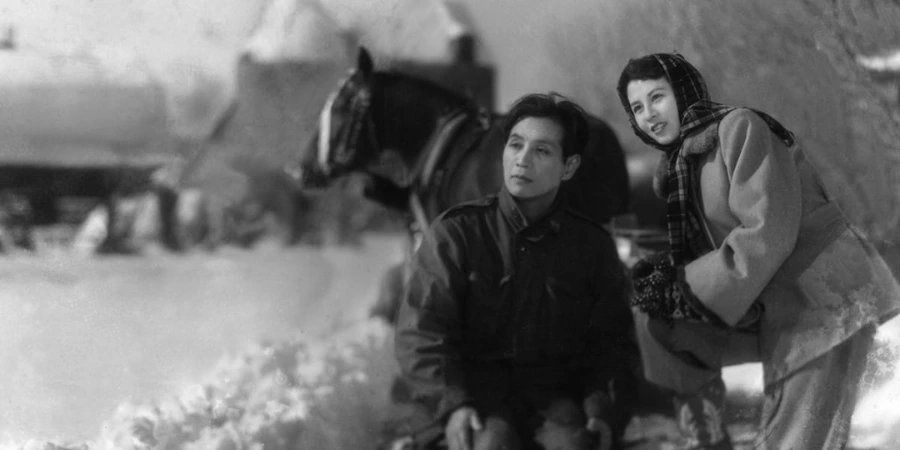
Scene of Kameda and Ayako venturing into the Hokkaido snow.
Akira Kurosawa’s The Idiot is a fascinating work of art, one whose ambition is only matched by the source material it so passionately wanted to bring to the silver screen. It’s an adaptation that aims to profoundly comprehend the novel rather than merely translate it. Much like Dostoevsky’s original, Kurosawa’s approach was experimental, ambitious, and, by all existing accounts, rough around the edges. A good part of it was lost; however, what remains is, miraculously, a film that achieves greatness in how it speaks directly from the director’s heart.
While often overlooked in favour of Kurosawa’s period dramas, The Idiot is an essential part of his filmography. It is one where he directly speaks to what he sees as the moral failures of postwar Japan, tackles the psyche of a nation scarred by defeat, and does justice to one of literature’s greatest writers. Seen this way, The Idiot is not a minor curiosity of Kurosawa’s career, nor a film haunted by the “what ifs,” but one of his most daring and intimate conversations with another artist.