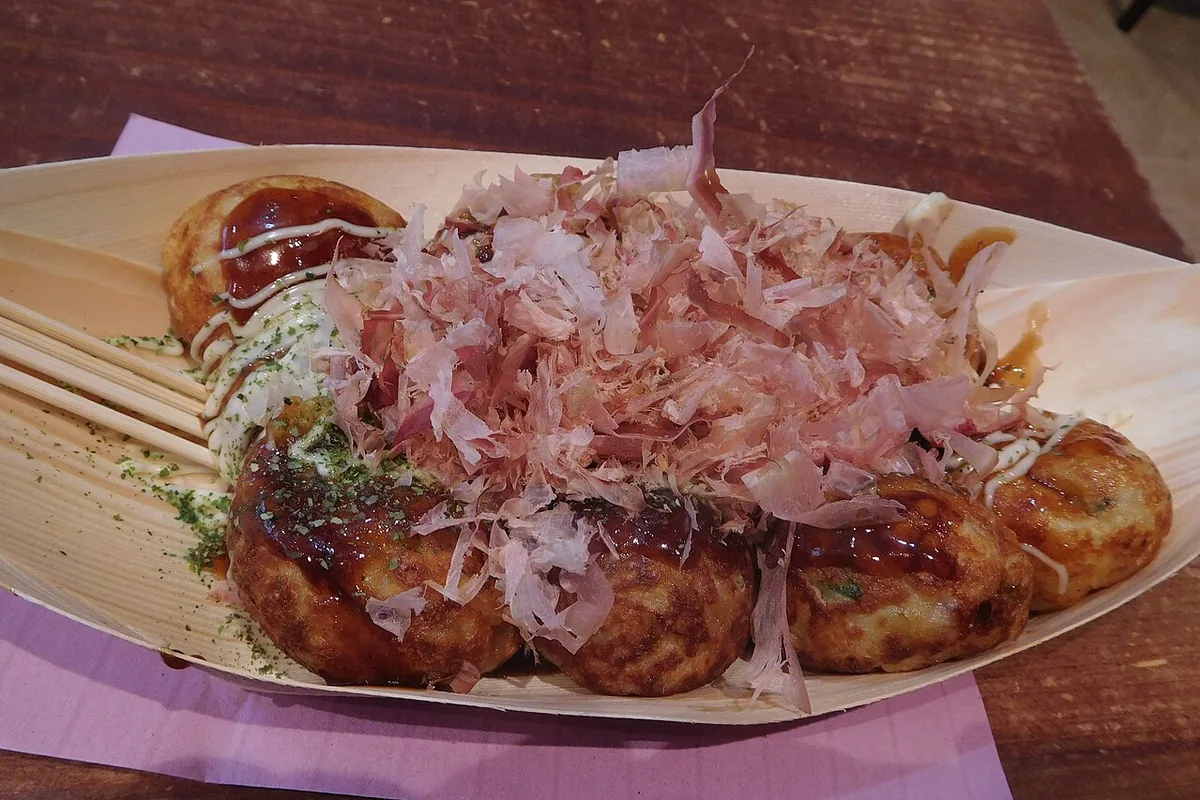
Takoyaki are bite-sized balls of savoury batter with a piece of octopus in the middle, cooked in a cast iron plate of round hollows and turned with a pick until they are crisp outside and soft, almost molten, inside. They come from Osaka, where a street vendor called Tomekichi Endo first sold them in 1935, and they are still the city’s favourite snack.
This guide covers where takoyaki came from in Endo’s own shop’s words, how they are made, four Osaka stands with their addresses and hours, how to make them at home in the UK and where to find them in London.
Takoyaki in Osaka, London and Your Own Kitchen
| What it is | Batter balls filled with octopus, cooked in a hemispherical cast iron plate (takoyaki means “grilled octopus”) |
| Invented | 1935, by Tomekichi Endo of Aizuya, Osaka |
| Classic toppings | Sauce, mayonnaise, aonori seaweed and katsuobushi bonito flakes. Aizuya’s original has none |
| Where to eat it in Osaka | Aizuya in Tamade, and the Dotonbori, Sennichimae and Amerikamura stands |
| To make it at home | A takoyaki pan (Sous Chef sells a 14-hole cast iron one for £85), dashi, plain flour, eggs and cooked octopus |
| In London | Japan Centre Westfield, Okan’s takoyaki parties in Brixton and Shōtengai market at King’s Cross |
Who invented takoyaki: Tomekichi Endo and Aizuya, 1935
Takoyaki has a named inventor, which is rare for a street food. According to Aizuya’s own history, Tomekichi Endo was born in 1907 in Aizubange, in Fukushima Prefecture, and in 1933 opened a street stall in Imazato, Osaka, selling radio-yaki, a children’s snack of batter cooked with beef, konjac and beans.
Endo wanted something adults could eat with one hand while holding a beer, and that still tasted good once cold. The shop’s account of the breakthrough is a customer’s remark: “Osaka puts meat in it? In Akashi they use octopus.” Akashi, in neighbouring Hyōgo Prefecture, is famous for its octopus and for akashiyaki, a soft egg-rich dumpling eaten in dashi. Endo swapped the meat for octopus, started mixing his flour with soy-seasoned dashi, and in 1935 called the result takoyaki. It sold immediately, the shop says.
Sauce came later. Other Osaka stalls added sauce, salt, aonori and mayonnaise over the following decades, and that dressed-up version is the one most people picture today. Aizuya still serves the original plain, so the dashi in the batter carries the flavour, with vinegar soy, Worcestershire sauce or chilli powder on the side if you want them.
| Year | What happened at Aizuya |
|---|---|
| 1933 | Tomekichi Endo opens a radio-yaki stall in Imazato, Osaka |
| 1935 | Octopus replaces meat and the snack is named takoyaki |
| 1936 | The shop’s red curtain with “takoyaki” in white letters is made |
| 1949 | The shop moves to Tengachaya |
| 1965 | Yoshizo Endo becomes second-generation owner |
| 1993 | The main shop moves to Tamade in Nishinari, where it is today |
| 1997 | Masaru Endo becomes third-generation owner |
| 2005 | The original radio-yaki returns to the menu after 70 years |
| 2016 to 2018 | Bib Gourmand in the MICHELIN Guide three years running |
Aizuya also publishes what its takoyaki cost over the years. In 1935 two balls cost one sen, a hundredth of a yen. By 1960 the price was twelve for 30 yen, and in 1990 twelve for 400 yen. Today the business has eleven shops, mostly in Osaka plus one inside the Odaiba Takoyaki Museum in Tokyo.


Map of Aizuya Honten
How takoyaki are made
The batter is thin, closer to a pancake batter loosened with dashi than to anything doughy. It goes into a heavy cast iron plate of round hollows, heated until a drop sizzles, and is poured right to the top so it floods across the plate. A piece of boiled octopus goes into each hollow, usually with tenkasu tempura scraps, spring onion and pickled ginger scattered over the lot.
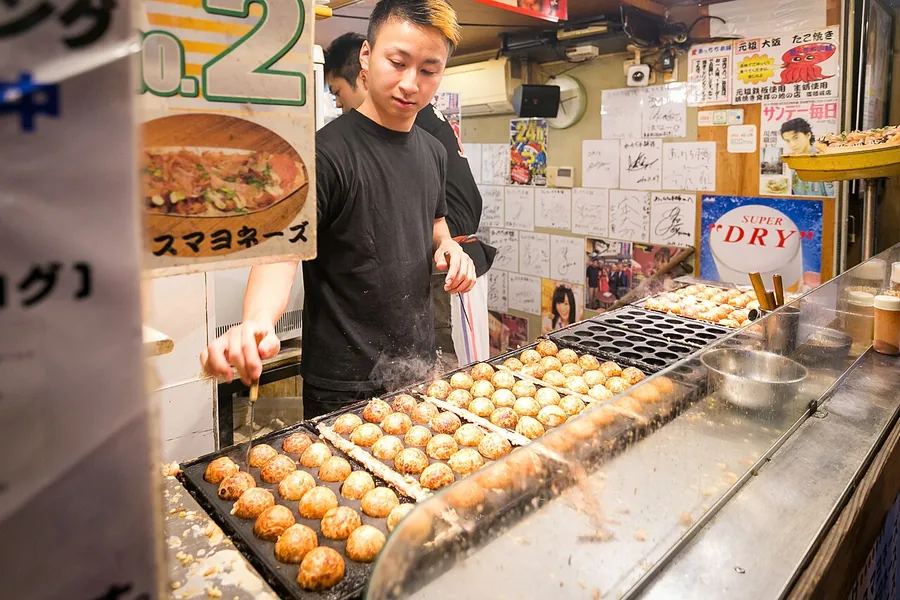
Once the bottoms set, the cook runs a pick along the lines between the hollows to cut the batter apart, then turns each ball a quarter turn. The raw batter inside runs down to form the other half. A few more turns close the sphere and crisp the outside. Aizuya’s own instructions turn each ball three times: once to flip it, once while pushing in the stray edges, and once more to roll it smooth.
At most Osaka stands the balls then get takoyaki sauce, mayonnaise, aonori and bonito flakes. Kogaryu in Amerikamura says it is where the criss-cross drizzle of mayonnaise began, and it adds mayonnaise to every portion unless you ask it not to. If you want to try the rest of Osaka’s flour-based dishes, from okonomiyaki to negiyaki, our essential Osaka food guide picks the places for each.
Where to eat takoyaki in Osaka
Takoyaki is sold all over Osaka, from department store basements to festival stalls, but four names come up again and again. These are their own addresses and hours as listed on their websites on 31 October 2026.
| Stand | Address | Since | Known for | Hours |
|---|---|---|---|---|
| Aizuya Honten | 2-3-1 Tamadenishi, Nishinari-ku. Tamade Station (Yotsubashi Line), exit 1 | 1933 | The plain original, no sauce | 11am to 9pm, closed 1 January only |
| Takoyaki Doraku Wanaka, Sennichimae Honten | 11-19 Nanbasennichimae, Chuo-ku. Namba Station (Midosuji Line), exit 3, 5 minutes | 1986 | A choice of sauce, salt, soy or spicy sauce, and takosen | Monday to Friday 10:30am to 9pm, weekends and holidays 9:30am to 9pm |
| Takoya Dotonbori Kukuru Honten | Hakua Building 1F, 1-10-5 Dotonbori, Chuo-ku | Its 40th year in 2025 | Big pieces of octopus finished with a splash of white wine | Takeaway Monday to Friday 10:30am to 9:30pm, weekends and holidays 10am to 9:45pm |
| Kogaryu Amerikamura Honten | 2-18-4 Nishishinsaibashi, Chuo-ku | More than 50 years | Sauce and a criss-cross of mayonnaise | 10:30am to 8:30pm, to 9:30pm on Saturdays and the day before holidays |
Aizuya in Tamade: the plain original
Aizuya Honten sits in Nishinari, south of the tourist centre, by exit 1 of Tamade Station on the Yotsubashi subway line. It has seats and sells beer, does not take table bookings, and accepts cash, cards, transport IC cards and PayPay, its FAQ says. Try a plate of the original next to the radio-yaki, its konjac-filled ancestor, and the difference the octopus made is obvious. If Tamade is out of your way, Aizuya has branches at Namba Walk, NAMBA Nannan, Tennoji Mio, KITTE Osaka and Universal CityWalk Osaka, all listed on its shop page.
Dotonbori and Namba stands: Wanaka and Kukuru
Takoyaki Doraku Wanaka began in 1986, when the current chairman started cooking takoyaki outside his family’s sweet shop in Sennichimae. The original shop still has the longest menu: takoyaki with sauce, kamataki salt, dashi soy or spicy sauce, takosen (three takoyaki pressed between prawn crackers) and wanko-dako, takoyaki dipped in warm dashi like akashiyaki. The Dotonbori branch at 1-6-7 Dotonbori, open 10:30am to 9pm, takes cash or PayPay only. Wanaka also runs a counter in Kuromon Ichiba Market, handy if you are grazing there anyway.
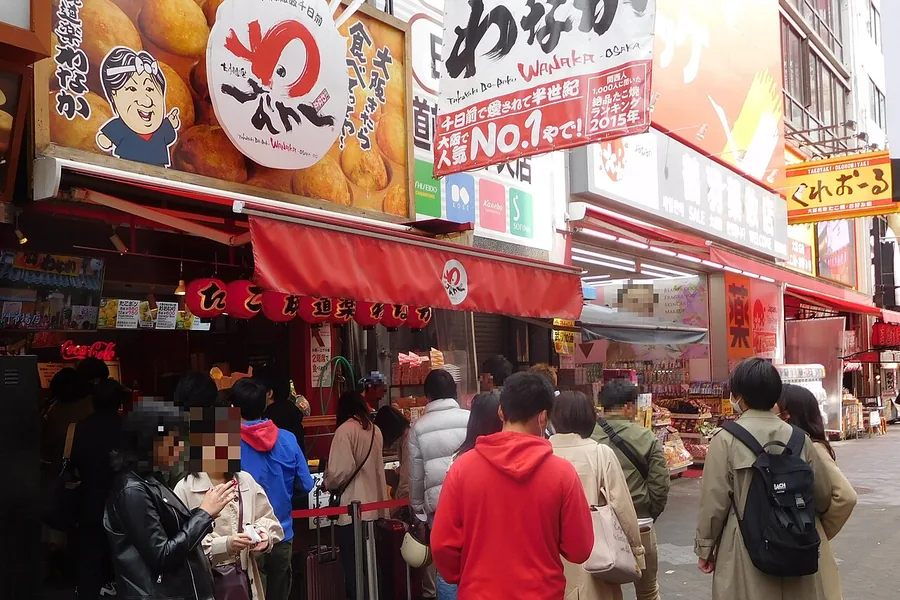
Takoya Dotonbori Kukuru, run by Shirohato Foods, marked its 40th year at its Dotonbori main shop in 2025. Its standard takoyaki use large pieces of octopus and get a splash of white wine at the end, and the main shop adds “bikkuri takoyaki” with tentacles poking out. A few doors along at 1-6-12 Dotonbori, its Konamon Museum shop runs a takoyaki class where a professional teaches you to cook 15 balls, served with two of Kukuru’s own and a soft drink, for 3,850 yen.


Map of Takoya Dotonbori Kukuru Honten
Both Kukuru shops and Wanaka’s Dotonbori branch are on Dotonbori itself, so it is easy to compare two in one evening. Our Dotonbori canal guide has the ninety minute loop that fits them in between the river cruise and the arcades. If you are still deciding whether to base yourself in Osaka or Kyoto, our Kyoto or Osaka comparison sets the two cities side by side.
Kogaryu in Amerikamura: where the mayonnaise lattice began
Kogaryu has cooked takoyaki in Amerikamura for more than half a century. Its batter uses a dashi built from seven bases including kombu and iriko dried sardines, plus grated yam, its octopus is the same madako sold for sashimi, and its sauce is a fruity blend of apple and onion. The shop says it is where the criss-cross of mayonnaise began, made with egg yolks only so it is less sharp than supermarket mayonnaise. Order the sauce and mayonnaise version first, then the negi pon, heaped with spring onion and ponzu.
Making takoyaki at home in the UK
You need a takoyaki pan. Electric plates exist, but a cast iron one on the hob gives the crisp shell. Sous Chef sells an 18cm cast iron takoyaki pan with 14 hollows for £85, and it works on induction. The same shop stocks okonomi sauce, Kenko mayonnaise, katsuobushi and instant dashi powder, so one order covers everything except the octopus.
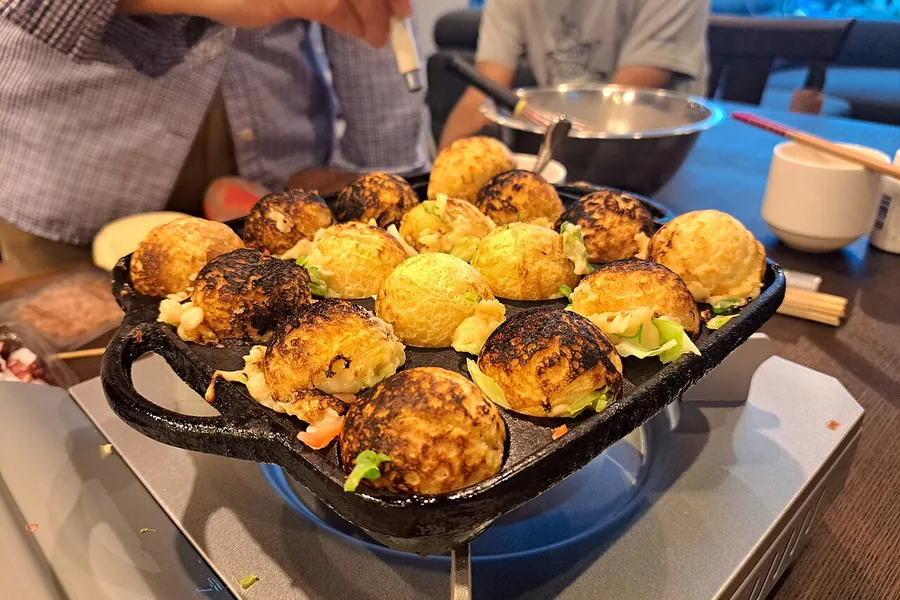
This batter, from Sous Chef’s takoyaki recipe, is in UK measures and makes two to three panfuls in a 14-hole pan:
- 200g plain flour
- 2 eggs
- 700ml ice-cold water (or strained water from cooking the octopus)
- 1 tsp instant dashi powder
- 2 tsp soy sauce
- ¼ tsp salt
- Filling: cooked octopus cut into 1cm pieces, plus sliced spring onion and pickled ginger if you like. Cooked squid, smoked sausage, hard cheese or sweetcorn also work.
- To finish: okonomi or takoyaki sauce, Kenko mayonnaise, aonori and katsuobushi
- Whisk the eggs, water, dashi powder, soy sauce and salt. Sift in the flour a third at a time and stir gently. A few lumps are better than an overworked batter.
- Heat the pan over a medium to high heat and oil every hollow generously with folded kitchen paper.
- When a drop of batter sizzles, fill each hollow and let the batter spill over the top. Drop in a piece of octopus, then scatter over spring onion and ginger.
- When the edges brown, cut the batter along the lines between the hollows with a skewer or chopstick and turn each ball a quarter turn, tucking the loose edges in.
- Turn again after a minute or two so the round side faces up. Keep rolling until the balls are golden all over and sound hollow when tapped.
- Pile onto a plate, add sauce and mayonnaise, then aonori and bonito flakes. They are very hot inside, so wait a minute.
The first batch usually sticks. The second is always better, as the pan seasons with the oil.
Where to eat takoyaki in London
In London, takoyaki turns up in a food hall, on a restaurant’s party menu and at a monthly market.
- Japan Centre Westfield London, Relay Square, ground floor, Westfield London W12 7HB. Japan Centre’s food hall cooks takoyaki alongside sushi, ramen and katsu curry in its open kitchens. It is a short walk from Wood Lane and Shepherd’s Bush stations.
- Okan, Brixton East, 338 Coldharbour Lane, SW9 8QH. Okan was founded by Moto, who came to London from Osaka in 1998 and began with a market stall on Brick Lane. Its menu lists a hands-on takoyaki party at the Brixton East branch for groups of four to eight, by reservation only: the Sakura course is listed at £42.50 and the Kuidaore course at £62.50.
- Shōtengai market, King’s Cross, Lower Stable Street, N1C 4LW. King’s Cross lists Takoyaki Iseji among its past food traders. The next market runs from Thursday 19 to Sunday 22 November 2026, noon to 7pm on Thursday and Friday and 11am to 6pm at the weekend. Check Takoyaki Iseji’s Instagram before you go, as the traders change each month.
For the rest of the capital’s Japanese food, one dish at a time, see our pick of London’s best Japanese food by dish type.
Takoyaki questions and answers
Takoyaki batter is wheat flour, egg and dashi stock, seasoned with soy sauce. Each ball holds a piece of boiled octopus, usually with tenkasu tempura scraps, spring onion and pickled ginger. Most Osaka stands finish them with takoyaki sauce, mayonnaise, aonori seaweed and katsuobushi bonito flakes, though Aizuya, which invented them, serves them plain.
Tomekichi Endo, founder of Aizuya in Osaka, created takoyaki in 1935. He had been selling radio-yaki, a batter snack with beef and konjac, since 1933, and replaced the meat with octopus after a customer pointed out that Akashi used octopus. Aizuya’s main shop is now in Tamade, Nishinari, and is run by the third generation of the family.
Akashiyaki, from Akashi in Hyōgo Prefecture, is a softer, egg-rich octopus dumpling dipped in warm dashi before eating. Takoyaki has a firmer, crisper shell and is eaten with sauce or plain. Akashiyaki is older and inspired takoyaki. In Osaka, Kukuru sells both, and Wanaka’s wanko-dako serves takoyaki in dashi.
No. Takoyaki use octopus that has already been boiled, cut into small pieces, then cooked again inside the batter. If you cannot find cooked octopus, Sous Chef’s recipe suggests any cooked filling with some texture instead: squid, smoked sausage, cubes of hard cheese or sweetcorn all hold up well inside the batter.
Not properly. The round hollows are what let you turn the batter into a sphere, and Sous Chef notes that baking the batter in an oven tray only gives dense half-balls. A cast iron takoyaki pan costs £85 at Sous Chef, which says it also works on induction hobs.
Japan Centre’s food hall at Westfield London cooks takoyaki in its open kitchen, and Okan’s Brixton East branch runs bookable takoyaki parties for four to eight people. Takoyaki Iseji has traded at the monthly Shōtengai market on Lower Stable Street, King’s Cross, which next runs from 19 to 22 November 2026.