Navigating a new country comes with its own practical hurdles, and mail is often one of the first. For travellers in Japan, understanding the postal system matters for everything from receiving official documents to sending parcels back home. This guide breaks down Japan Post services, domestic forwarding, international shipping options, and the everyday tips that make the system feel effortless.
Understanding Japan’s Mail System

A classic round, red post box (maru-gata post), a nostalgic symbol often found in historic or scenic areas of Japan. Source: Tokyo Cheapo
Japan’s postal service, Japan Post (日本郵便, Nippon Yūbin), is known for efficiency, reliability, and a nationwide network. With post offices and bright red mailboxes across the country, it’s a daily-life staple, especially for admin-heavy communications that still arrive on paper.
Key features of Japan Post
- Extensive network: Post offices exist nationwide, including rural areas.
- Reliability: Deliveries are punctual; lost mail is rare.
- Diverse services: Mail, parcels, banking, insurance, and more.
- English support: Not universal, but major post offices and the official site often support English.
Types of mail services
- Standard Mail (定形郵便, Teikei Yūbin): Letters and small documents, ¥110 up to 50g. A postcard is ¥85. Both went up on 1 October 2024, the first significant rise in three decades, and the old 25g band was merged away, so one price now covers everything up to 50g. Allow two working days at the very least: Japan Post pushed ordinary mail back by about a day in October 2021 and stopped delivering it on Saturdays and Sundays at the same time, so a Thursday or Friday posting will not arrive before Monday.
- Non-Standard Mail (定形外郵便, Teikeigai Yūbin): Larger letters and small parcels beyond standard size/weight limits.
- Yu-Pack (ゆうパック): Domestic parcel delivery with options such as COD and temperature-controlled shipping.
- LetterPack (レターパック): Flat-rate A4 envelopes for documents and small items, tracked, up to 4 kg, one price anywhere in Japan.
- LetterPack Plus (¥600): Handed over in person and signed for. No thickness limit, which is the reason to pay the extra.
- LetterPack Light (¥430): Dropped in the mailbox, no signature, and the contents must be under 3cm thick.
- Registered Mail (書留, Kakitome): Added security, tracking, and compensation for loss/damage.
Finding post offices and mailboxes
Japan Post locations are marked by a red logo and the 〒 postal symbol. Mailboxes are also red and often have two slots:
- Standard letters/postcards
- Non-standard mail (larger items)
How to Forward Mail Within Japan

A standard modern Japanese post box, typically found on street corners for convenient mail collection. Source: E-Housing
Moving in Japan means setting up mail forwarding early so nothing important slips through the cracks. Japan Post offers a free forwarding service called Tenkyo Todoke (転居届). There are three ways to file it: at a post office counter, by dropping the completed form in a postbox, or online through e-Tenkyo (e転居), on the website or in the Japan Post app. The online route needs a Yu-ID with identity verification already completed, which is a one-off step. Whichever route you use, allow about a week before forwarding actually starts, so file it before you move rather than after.
Steps to set up mail forwarding (Tenkyo Todoke)
- Obtain the form
- Pick up a Tenkyo Todoke form at any Japan Post office.
- It’s primarily in Japanese, but staff may assist or offer guidance.
- Fill out the form
- You’ll typically need:
- Previous address (旧住所, kyū jūsho)
- New address (新住所, shin jūsho)
- Name (氏名, shimei)
- Desired forwarding start date
- Names of family members moving with you
- Contact phone number
- You’ll typically need:
- Provide proof of identity
- Commonly accepted:
- Residence Card (在留カード, Zairyū Kādo)
- Driver’s licence
- You may also need proof of your new address (utility bill or rental agreement).
- Commonly accepted:
- Submit the form
- Hand the completed form to post office staff for processing.
- Receive confirmation
- Forwarding usually begins within a few business days.
- A confirmation postcard is commonly sent to confirm setup.
Important notes
- Duration: Forwarding lasts exactly one year from the start date and does not renew itself. Once it lapses, mail goes back to the sender rather than on to you, so if you are still at the new address after a year you must file a fresh Tenkyo Todoke. This catches people out.
- Not universal forwarding: This covers Japan Post mail, but you still need to update addresses manually with:
- Banks
- Utilities
- Mobile providers
- Government offices
- Subscriptions
- Family mail: List all names so mail for each person is forwarded correctly.


International Mail Solutions
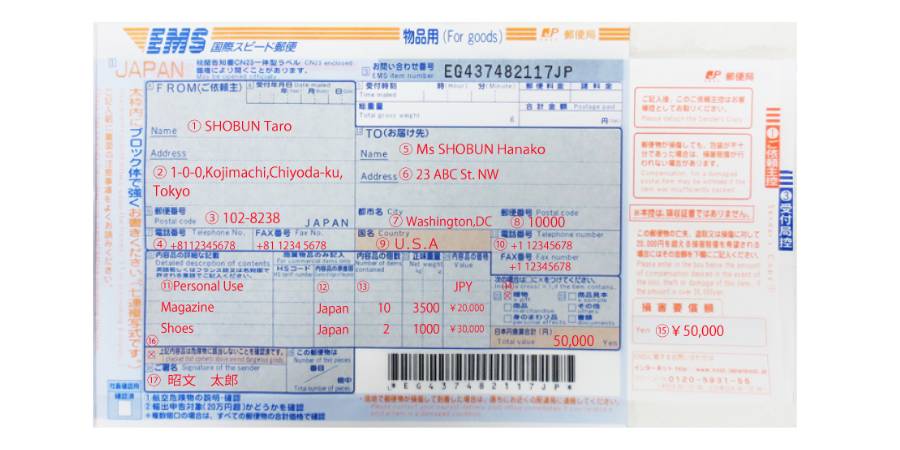
A sample EMS (Express Mail Service) shipping label provided by Japan Post for international delivery of goods. Source: DigJapan!
Sending mail internationally from Japan is fairly straightforward, but long-term travellers and remote workers often prefer a more flexible setup. Mail forwarding services allow you to receive, scan, forward, or securely store mail digitally, useful if you’re managing life across multiple countries.
Key international services
1) EMS (Express Mail Service)
- Best for: Urgent documents and reliable express shipping
- Includes: Tracking and insurance
- Delivery time: Japan Post’s published standard for the UK is 5 days from Tokyo, excluding the day you post it. Germany is also 5, France 6, the Netherlands 8.
Note: always check country-specific restrictions and prohibited items before you pack. Delivery in the UK is Monday to Friday only, and customs can add time on top.
2) Airmail (航空便, Kōkūbin)
- Best for: General letters and small packages
- Trade-off: Cheaper than EMS, slower delivery
- Delivery time: Japan Post’s published standard to the UK is 12 days for letter post from Tokyo, and 8 days for an airmail parcel. That is slower than most people assume, so if something has a deadline, pay for EMS.
3) SAL / Economy Airmail (エコノミー航空便, Economī Kōkūbin): suspended
- SAL used to sit between airmail and surface on both price and speed. Japan Post suspended it in 2020 and it has not come back. Its own SAL page still carries the notice that the service is unavailable, so ignore any guide that still lists it as an option.
4) Surface Mail (船便, Funabin)
- Best for: Heavy, non-urgent items
- Trade-off: The slowest option, and tracking may not be available
- Delivery time: Japan Post publishes no standard figure for surface mail, so treat it as months rather than weeks and do not use it for anything you need by a date. With SAL gone, this is now the only budget option for a heavy parcel.
Sending process
- Package securely
- Post offices sell boxes and packing materials.
- Complete customs declaration
- International parcels require a customs form (税関告知書, Zeikan Kokuchisho).
- Declare contents and value.
- Address clearly
- Write recipient address clearly in English.
- Add your return address.
- Take it to the post office
- Staff will weigh it, calculate postage, and attach labels.
- Use tracking if available
- Services like EMS provide a tracking number (追跡番号, tsuiseki bangō).
Important considerations
- Prohibited items: Rules vary by destination (batteries, aerosols, food, liquids, etc.).
- Customs fees: The recipient may pay duties/taxes upon arrival.
- Insurance: Consider additional coverage for valuable items.
- Postage estimates: Japan Post offers an online calculator for delivery times and costs.
Banking and Financial Mail

Credit cards and financial documents are sent as Mail in Japan.
Japan still relies heavily on physical mail for finance-related admin. Expect banks, utilities, and government offices to send official notices to your registered address.
Common types of financial mail
- Bank statements (sometimes optional online)
- Credit card bills and statements
- New cards and passbooks (通帳, tsūchō)
- Utility bills (electricity, gas, water, internet)
- Insurance policy documents and renewals
- Tax documents from the tax office (税務署, Zeimusho)
- Pension and healthcare notices
Important practices
- Update your address quickly with banks and providers to avoid missed payments or account issues.
- Handle documents securely and shred sensitive mail before disposal.
- Translate carefully: Many documents are Japanese-only, use translation apps or ask a bilingual friend.
- Understand payment slips: Many bills include payment slips (振込用紙, furikomi yōshi) usable at convenience stores, banks, and post offices.
Best Practices and Tips

A person mailing an envelope using a standard Japan Post collection box in an urban neighbourhood.
A few small habits can make Japan’s mail system feel unbelievably smooth.
Practical checklist
- Keep a written copy of your full address and postal code (郵便番号, yūbin bangō) somewhere other than your phone, so you can hand it to a post office clerk or a courier.
- An eSIM is worth having for this, since rescheduling a missed delivery and tracking a parcel both happen online.
- Always include the 7-digit postal code to speed processing.
- Write clearly in block letters to reduce misdelivery risk.
- Ensure your name is visible on your mailbox, especially in apartments.
- Learn how to use missed-delivery slips:
- If you miss a delivery, you’ll get a notice (不在連絡票, fuzai renraku hyō)
- Use it to reschedule delivery or pick up at the post office
- Know typical post office hours:
- Many offices: 9:00 to 17:00 weekdays
- Limited Saturday hours; often closed Sundays/holidays
- Central offices may have extended/weekend hours
- Use Japan Post online tools for:
- Tracking
- Postage estimates
- Post office locator
- Use translation apps (or bring help) if language becomes a barrier.
- For longer absences, file a Fuzai Todoke (不在届) and Japan Post will hold your mail at the delivery office for up to 30 days, free. Everything arrives together on the day after the hold ends. Unlike change of address, this one has no online option: take the form and your ID to the post office that delivers to you, or your nearest branch.








Emergency Contacts
Japan Post is extremely reliable, but on the rare occasion something goes wrong, these details help.
Japan Post customer service
- English: 0570-046-111. This is the line to ring. Japan Post labels it 英語受付, For English. Call charges apply.
- Japanese, from a mobile: 0570-046-666. Call charges apply.
- Japanese, freephone from a landline: 0120-23-28-86 for domestic post, or 0120-5931-55 for international post. Neither works from a mobile.
- All of these are open 8:00 to 21:00 JST, every day including weekends and public holidays. None of them can be reached from outside Japan.
- Website: Japan Post’s English international mail pages carry the rate and delivery-day calculator, the tracking tool, and a country-by-country check of which services are currently being accepted.
If mail is lost or damaged
- Contact Japan Post customer service as soon as possible.
- Have your tracking number (if available) and item details ready.
Mail fraud or suspicious mail

An illustration depicting common themes of phone and mail fraud targeting vulnerable individuals.
- Contact Japan Post customer service for guidance.
- In serious cases, contact local police:
- 110 for emergencies
- Or visit a local police box (kōban)
Conclusion
Japan’s postal system reflects the country’s obsession with reliability. It is predictable, carefully tracked and deeply integrated into everyday life, though it is slower than its reputation suggests since the 2021 and 2024 changes, so build in a few extra days. Once you know the service types, how forwarding works, and how to handle missed deliveries, the entire system becomes easy to manage.
Stay on top of address updates, use tracking for important deliveries, and don’t hesitate to ask for help when language gets in the way. With those habits in place, you can handle everything from daily letters to high-stakes financial notices, and send parcels abroad with confidence.