Many of Japan’s foods and cultural practices relate to seasonal changes. Winter brings with it kotatsu and citrus fruits such as mikan oranges and yuzu, whereas autumn welcomes the new rice harvest and the first batch of sake. While these customs shape Japanese seasonal dining culture overall, some traditions offer year-round flexibility. One of the simplest ways to taste Japanese culture any time of year is through umeshu.
Navigating Japanese Food Categories
What is Umeshu?

Umeshu is a drink made with green Japanese ume, sugar and alcohol. Technically, umeshu translates to ‘plum alcohol’ but it’s often referred to in the West as ‘plum wine,’ though that name isn’t all that accurate.
To begin with, it’s not fermented so it is not a wine, secondly, ‘ume’ refers to Prunus mume, a fruit tree also known as the Japanese apricot (the fruit itself sits somewhere between a plum and an apricot).
Making umeshu usually starts during late spring or early summer while the ume fruit is unripe. The steeping time of the ume in the alcohol is left to the brewer’s discretion but normally takes between 3-12 months. There are some umeshu brewers however who age the product for multiple years. As a liquor, it is on the sweet side, but it is well balanced with a sour backbone and an underlying umami note. Although umeshu may be relatively new to many around the world, it is one of Japan’s most popular alcoholic beverages especially in the summer and among individuals who do not like or consume much alcohol.


A brief history of umeshu
In the famous ‘Man’yōshū (dated 750), Japan’s oldest collection of waka poems, the visually appealing ume blossoms are incorporated into 118 poems, compared to only 42 for cherry blossoms. ‘Honzō Wamyō’, the oldest Japanese dictionary of pharmacy (dated 918), also mentions ume. In this text, ume is described as a medicinal agent that relieves parched and sore throat, stops the accumulation of phlegm, improves appetite, and dissolves poisons.
Even to this day, when made with real plums, many believe umeshu provides several health benefits such as an aid for gastrointestinal issues and a fatigue reducer due to the energising effects of citric acid and other antioxidants in the liqueur.

The actual term ‘umeshu’ appears for the first time in the Honchō Shokkan, a book of Japanese cuisine first published in 1697, but it is believed to have been brought from China to Japan as a medical drink as early as the eighth century. Skip to the present day, and there are over 300 varieties of umeshu in the domestic Japanese market — varying widely in price and quality, and spanning the full spectrum of demand. A few large companies – such as Choya – produce umeshu using industrial mass production methods. There are also a large number of small, private producers, who make very unique umeshu. It is due to the efforts of these companies (often managed by the same families for generations) that umeshu remains such an interesting beverage.
The three components of umeshu (plus a fourth)
Umeshu’s life cycle begins when the green ume fruit is combined with sugar and shochu, sake, whisky, brandy or other alcohols and then left to mature for a determined period of time before being consumed. It’s deceptively simple, but each ingredient plays an essential role — the finished product is much more than the sum of its parts.
Fruit
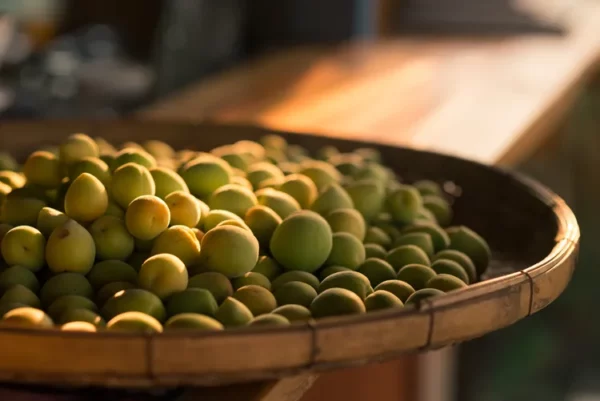
Ume is native to southern China, where it has been cultivated for more than 2,000 years, and was later introduced to Korea and Japan, long revered in Japan where it is a highly valued ingredient in the national cuisine. Japanese ume can be difficult to find outside of Japan although not impossible. A good substitute is unripe greengages which can be found more readily, especially in Europe.
It is important when making umeshu to avoid using any ume that are bruised or damaged. The main reason is that if bacteria remain in the wounded area, they can easily become mouldy and ruin an entire batch of umeshu. Cutting off the damaged portion also is not recommended as the plum pulp will spread throughout the liquor from the cut portion of the fruit and cause the liqueur to become cloudy. It then becomes impossible to determine whether this cloudiness is intentional or due to the growth of bacteria.
It may be surprising to those who make umeshu for the first time to see the many changes that occur; it is natural for the plums to float, sink, and wrinkle. The fruit floats because as the sugar dissolves into the liquor, the liquor becomes denser than the fruit itself. However, it’s important to be careful while the fruit is floating since this means that the fruits are in contact with air, which increases the possibility of mould growth. While the fruit is floating, remember to shake the bottle gently once a day to make sure that the liquor is evenly distributed over the fruit.
Usually, the ume sink after a few weeks or months because sugar is drawn into the fruit from the liquor, making them denser than the liquor. However, if the amount of sugar is quite high, the density of the liquor may remain greater than the density of the fruit resulting in the fruit never sinking. Even if the fruit does not sink, it is not a problem, it just means that more care needs to be taken to ensure the frequent distribution of alcohol over the fruit during the ageing process. The reason why the ume may wrinkle is that the sugar in the alcohol draws out the water within the fruits. This is a natural phenomenon in the making of umeshu.
Fresh raw ume aren’t just unpleasant to eat — they contain low levels of natural cyanogenic compounds and shouldn’t be eaten raw. Once steeped in alcohol and sugar for around 6–12 months, however, the fruit becomes safe to eat, mellow and pleasantly soft. After about a year of ageing, many people choose to remove the ume from the umeshu as the fruit will eventually break down and make the liqueur cloudy. The removed fruit however does not need to go to waste and can be used in a variety of cooking and baking recipes.
Alcohol
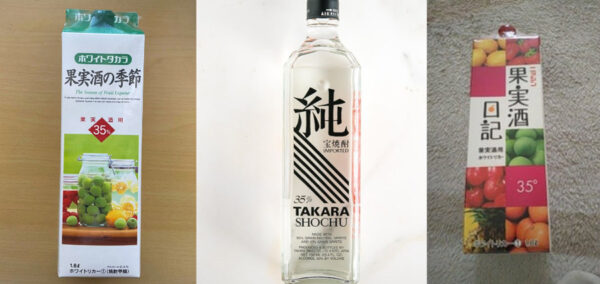
There are two main types of alcohol: brewed and distilled. Brewed alcohol (eg. beer, wine and Japanese sake) is fermented to produce alcohol, which is then filtered or otherwise processed before being sold and tends to have a lower alcohol percentage. Distilled liquor (eg. whisky, shochu, vodka) on the other hand undergoes a process called distillation, in which the brewed alcohol is evaporated at least once to increase its concentration (alcohol concentration tends to be above 20%).
When making homemade umeshu in Japan most people would use something called white liquor. It can be purchased quite cheaply and makes an umeshu with a clean and simple flavour. Of course, it is possible to make umeshu with other alcohols as well such as brandy, whisky, rum vodka or gin. For Japanese spirits, shochu and awamori are also delicious. When making umeshu at home it is recommended to always choose alcohol with at least 35% alcohol by volume.
Sugar
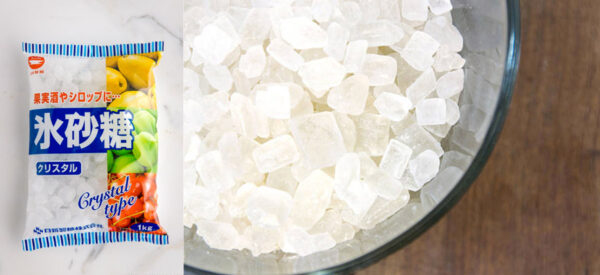
Image credits: Keltie Mechalski (left), Adobe Stock (right)
Although umeshu can be made with sweeteners such as honey or brown sugar it is more common to use rock sugar because the large sugar crystals dissolve slower allowing the sugar concentration to gradually increase as the liqueur ages.
The amount of sugar really depends on the recipe and type of alcohol used. Some recipes use as little as 10% of the fruit weight, while others use as much as 100%, and some use an equal amount. There is no ‘right’ quantity of sugar, it can be adjusted to taste.
Time and Maturation
With such a simple method and so few ingredients, the key to making such a delicious product is time. Most umeshu is aged for a year before being consumed but this is not a rule. It is fine to drink umeshu earlier, but the flavour will be quite different; possibly more tart and less fruity. Many producers let the beverage mature longer, which can produce more complex, deeper flavours.
The type of alcohol used also affects the time needed for maturation. Alcohol with a higher percentage will need less maturation time than alcohol with a lower percentage.
Homemade umeshu recipe
Making umeshu at home is genuinely simple: ume, sugar and a base spirit are the only ingredients. Combine them in a clean jar, leave the jar in a cool, dark spot for around twelve months, and you’ll have your own home-brewed umeshu ready to drink.

Image credit: Keltie Mechalski
What you’ll need:
- A 3-L glass jar
- 2 bottles (1.4L) of shochu or vodka
- 725g green ume or greengage (greengages were used above)
- 580g white rock sugar (this can be found at most Asian supermarkets)
- First off, gather all the ingredients together. Rinse your jar thoroughly with soap and hot water and wipe with a clean towel. While the jar is still hot, pour boiling water and shake to clean and drain. Air-dry until completely dry. Dampen a clean towel with a bit of the alcohol you are using and wipe inside the jar.
- Wash and dry the fruit thoroughly. Remove all the stem ends from the fruit (a bamboo skewer or toothpick makes this easy) and discard any fruit with brown, cut or blemished spots.
- In the clean jar, put the fruit in a single layer then cover with a layer of rock sugar. Put another layer of fruit followed by sugar once again. Repeat this process until you’re done with the fruit and sugar. Pour over the alcohol, seal, write the date on the jar, and store in a cool, dark place (no refrigerator).
- Until the sugar has dissolved completely and the plums have sunk to the bottom, be sure to gently agitate the jar each day to mix the dissolving sugar and keep the plums covered in alcohol.
1 Year Later… It’s now time to try your homemade umeshu and savour the triumph of its maturation. Remove the plums from the jar and use them in other dishes (eg. eat with vanilla ice cream or turn them into jam). Take a sip of the umeshu straight out of the jar, dilute it with soda water or tonic for a simple cocktail, and try it chilled over ice or even warmed with a bit of hot water. For a more traditional twist, umeshu can also be enjoyed ochawari (ie. with green tea) as well. No matter how you choose to savour umeshu, enjoy it and share the tradition with those nearest and dearest.