A personal essay on horse-meat country, generals and the second time something stopped me in my tracks. By Conor Hodges.
Some things in life demand silence from you. In Kumamoto prefecture, perhaps my favourite place in Japan, I felt this odd arresting of my senses exactly twice.
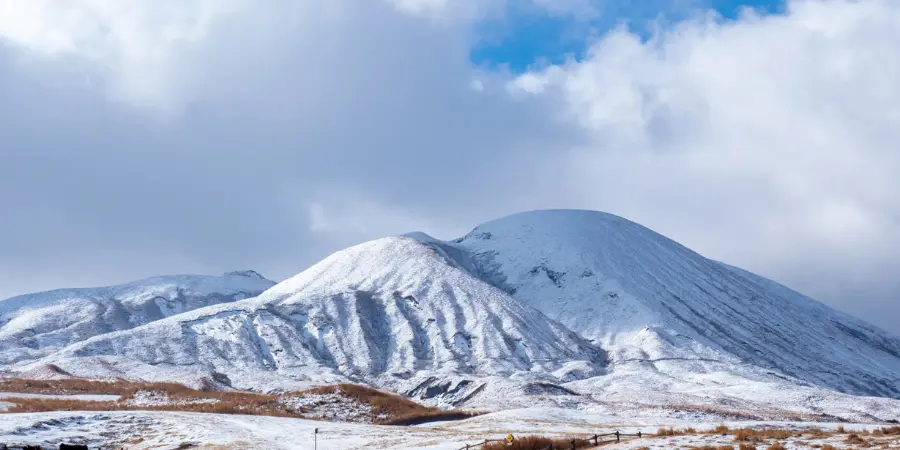
The first time was seeing a snow-covered Mount Aso in Aso Kuju National Park, a magnificently desolate stretch of primordial marshland towered over by Japan’s largest active volcano.
I had taken a short trip out from Kumamoto city to see the prefecture’s most famous site just before the new year, so the world felt both sleepy and heavy with anticipation for another turn round the sun. From my car window the sky felt far above me and the undulating hills looked to be ebbing away as I climbed further and further up the inclined road.
I passed a handful of cars already on their way back down and on either side of the road horses raised and lowered their heads to chew, digest, chew again the grass that carpeted the hills. What in summer appears as an endless meadow of verdant silk by December turns into a golden wheat-coloured expanse of grass that beams against the cloudless skies characteristic of Japan’s winter – something of a novelty to an English person like me.
At my chosen viewpoint, the sleet-grey Aso mountain, formed over an unfathomable stretch of time, felt almost incongruous, as if it had freshly sprouted from the ground, stolid amidst the horses and the marshes lightly bothered by the winds. I planted myself directly in front of the mountain, my vision rhythmically obscured by the vapour of my breath, and felt how I often feel when I am met with the sublime: a distinct lack of anything to say.
My mind emptied itself, keeping only the innate knowledge that I was smaller than I liked to think, that without me the world would revolve along its unalterable course and that I would turn to dust, replenishing the nutrients in a patch of soil here, nourishing a dense network of mushrooms there. I was finite, but the world didn’t have to be, and I thanked whatever force had brought me to that spot for giving me the chance to remember the pleasurable sting of winter wind, the dew on my eyebrows, the pulverising scale of it all.
The second time was eating horse sashimi.
Basashi: An introduction
Nowadays, mention Kumamoto and the prefecture’s ridiculously loveable mascot — Kumamon, who has long since outgrown his provincial origins — is likely the first thing that comes to mind. This jolly, hypnotically idiotic-looking black bear with perfectly circular red cheeks and an expression of vague surprise is one of the country’s most recognisable mascots and Kumamoto is proud of it. Official signs, packaging, even konbini welcome mats are adorned with Kumamon’s eternally cute face as far as you care to look. But before the dominance of the ever-smiling bear, the prefecture was famous for its horse meat, known as sakuraniku due to its beautiful pink colour. While you can even get Kumamon-shaped containers for your horse meat if you like your mascots a) almost anatomically accurate and b) edible, the meat usually comes intricately packaged and raw and thinly sliced, much like fish sashimi. This is known as basashi, a portmanteau of ‘horse’ and ‘sashimi’.
It’s easy to understand why it’s so popular. Not only is it absolutely delicious, it’s as varied as any other meat. Cuts from the loin look almost like wagyu, perfectly marbled with white veins running through the deep red of the meat, while leaner cuts such as those from the thigh are a darker red and look similar to a piece of lean tuna. What’s surprising is how light basashi can be. With only a fifth of the fat content found in a typical cut of beef, horse meat seems as though it should be tough, but it literally melts in the mouth and gives off a slightly sweet taste, elevated when paired with spring onions, ginger and sweet soy sauce. And if safety is a concern, horses’ naturally high body temperatures prevent dangerous bacteria from growing, so it’s one of the safest meats to eat raw.
But why did Kumamoto specifically become the place to get basashi? To answer that, we have to look back around 400 years, to the Imjin War — Japan’s two failed invasions of Korea between 1592 and 1598.
Kato Kiyomasa and the Origins of Basashi
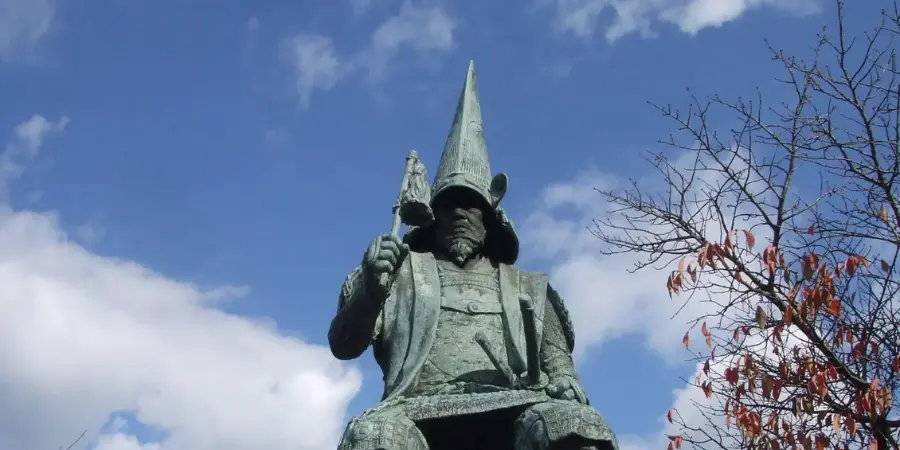
In the winter of 1597, in the Siege of Ulsan, a besieged half-built castle in southern Korea, General Kato Kiyomasa was starving. Searching for anything to sate his hunger, he alighted on an obvious – and delicious – answer, laying the foundation for Kumamoto’s love of horse meat. Allegedly.
When I think of Kato walking through the castle grounds, seeing around him the decay of his once-formidable forces in a land far from his home, it is easy to imagine him thinking that perhaps his luck had finally run out. After all, prior to this his career had been nothing short of illustrious.
Born in present-day Aichi prefecture in 1562, Kato came of age in the Azuchi–Momoyama period, a time characterised by feudal wars and changing fortunes. Kato and his family threw their weight behind the meteorically ascendant Toyotomi Hideyoshi, accompanying him in battle after battle. Kato eventually distinguished himself at the decisive Battle of Shizugatake in 1583, becoming known as one of the ‘Seven Spears of Shizugatake’ for his outsized valour. For Toyotomi and Kato alike, success meant much: the former consolidated his grip over the late Oda Nobunaga’s forces and Japan as a whole, while the latter became the lord of a large swathe of land in Higo, present-day Kumamoto.
With that, Kato began his own meteoric rise to the top of Toyotomi Hideyoshi’s government, eventually being sent to Korea to fight in both of Japan’s attempts to conquer the country. While his first expedition was uneventful, for the sake of Toyotomi’s obsession with subjugating the Koreans and humiliating their protector state – Ming China – Kato found himself for the second time in southern Korea, holed up at Ulsan Castle in the winter of 1597–98, with reinforcements more than two weeks away and food supplies fast dwindling. As the legend goes, something awoke in the starving Kato, a piece of his ancient soul stirring through the grumbles of his stomach. A desire to consume unthinkable quantities of meat of every variety that had lain dormant for around 1,000 years.

Breaking the Ban
In 673 AD in Nara, one of Japan’s former capitals, a new emperor was enthroned after a bloody succession crisis. Besides ossifying the foundations of what would become Japan’s imperial system during his rule, Emperor Tenmu, a highly religious man, was eager to spread and enforce Buddhist customs across his domain. Two years into his rule Tenmu imposed a ban on various meats, and with that eating animals such as chickens and horses at scale largely ground to a halt. While people often flouted the ban – and more commonly eaten meats such as deer and wild boar were conveniently left out of its prohibitions – the public consumption of meat was frowned upon and often associated with lower, ‘impure’ classes. But we are not in 673 AD. We are with Kato Kiyomasa and a retinue of hungry soldiers in the hinterlands of Korea at the dawn of the Edo period. Times and sensibilities had moved on, and a millennium-old edict banning horse meat counted for little against the very real possibility of not seeing the next sunrise.
And so, Kato and his men tucked into their horses. I imagine them finely slicing the meat into mouth-size slivers with accompanying sauces and condiments, but the reality was probably far more gruesome. In any case, Kato was able to hold out until reinforcements alleviated the siege and, so moved by his life-saving culinary adventure, he allegedly exported the practice back to Kumamoto, causing it to flourish.
While there’s no way of knowing if this legendary origin of Kumamoto’s most famous delicacy is true or not, by the twentieth century Kumamoto and horses were deeply intertwined. As Japan’s military swelled and along with it its demand for military equipment, Kumamoto and the rich pasture lands around the staggeringly beautiful Mount Aso became a hub of military horse production.
After the Second World War, these horses, now with nowhere to be sold to, became useful sources of food during the acute food shortages that swept across Japan. History repeated itself, and once again horses helped alleviate the hunger of a starving people, and this time no imperial edicts prevented meat-eaters from thriving. By the mid-1950s, horse meat restaurants were widespread in Kumamoto, and their practices were refined and tempered to create one of Japan’s most delicious and unique delicacies.
Basashi Today

Basashi has become an institution, and what better way to get familiar with a food, short of eating it, than seeing how it’s sold? Adverts abound extolling the nostalgic, ‘tastes-like-home’ experience of basashi. One famous Kyushu sake company’s advert series – ‘With the Flavours of Kyushu’ – features in its Kumamoto-targeted advert a majestic shot of Kumamoto Castle that fades into the careful preparation necessary for enjoying basashi, a giant slice of which is lovingly dipped into soy sauce and sumptuously swilled around as the music swells to a crescendo.
Fujichiku, a Kumamoto-based horse meat producer, has featured in its adverts the tagline ‘A taste of home, a taste that touches the heart, when it comes to Kumamoto, it’s basashi’, and have aired a slew of cloyingly sweet adverts of beaming grandparents waiting for their grandchildren to return, a gigantic platter of basashi at the ready to welcome them back to where they’ve always belonged. Basashi, then, has stuck in the public consciousness as a Kumamoto tradition, a warm reminder of home, and a delicious treat that gets the family back together.
Where to eat it?
If you’re taking a trip to Kumamoto, basashi should be on your list of foods to try. It’s considered one of Kumamoto’s ‘three delicacies’, the others being ikinari dango, a sweet potato dumpling with red bean paste, and karashi renkon, a lotus root stuffed with miso and mustard that may be one of the best things I have ever eaten in my entire life. But with basashi, I was hooked from the first bite.
If, like me, you’re from the English-speaking world, the idea of horse meat – or even raw meat in general – might be frowned upon or a bit much for you to stomach, but if you’re up for it, you won’t be disappointed. And with that I return to my second encounter with the sublime.
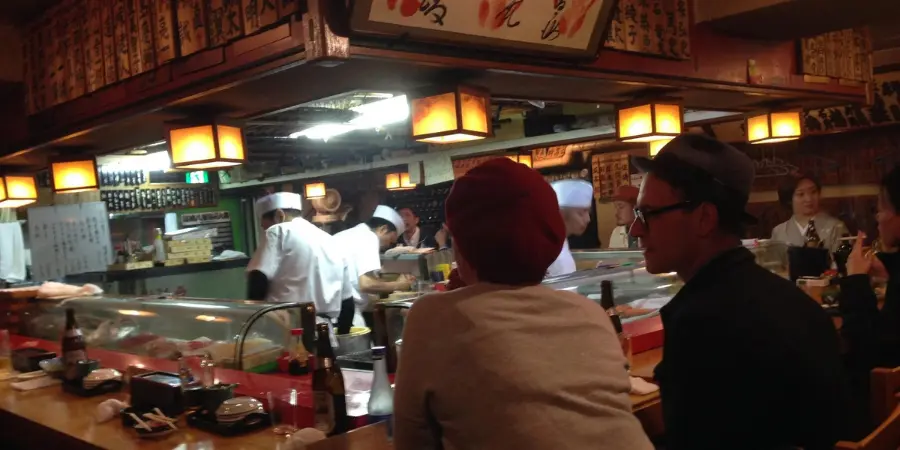
After coming back to Kumamoto city from Mount Aso, my host took me to a local spot called Sumo Sushi, an intimate underground sushi restaurant with a handful of chefs in the middle of the space surrounded by a square ring of customers. The low ceilings and the wooden sign-clad walls sat a bit at odds with the blood-red counter, but as my corner of the restaurant filled up with empty glasses and plates, the flotsam of my culinary conquest, I had no doubt I was in some form of personal paradise. Each chef worked deftly as orders came at them from all directions, and the atmosphere was impeccable.
My host and I continued ordering a steady stream of plates and the drinks were flowing, and then suddenly he turned to me, lightly running his fingers through a sparse beard anchored by a weighty moustache that gave him the air of an old statesman, or perhaps a general of times long past? No, no . . .
‘Do you consider horses to be friends or food?’ He asked me with the barely perceptible lift of an eyebrow, and dare I say even a wry smile.
Stunned by the question, my answer left him no recourse but to decide for me.
Both,’ I said.
And with that, he ordered regular basashi and rebasashi, a dish made from raw horse liver, and before I knew it the expressionless chef had placed the two dishes before me and turned his back to us. Not wanting to offend, I put some wasabi onto the meat and dipped it into the soy sauce just like the adverts had taught me, and I ate it.
‘Well? What do you think?’
‘It’s amazing.’
I had become a basashi fan. Even writing this now, I can so distinctly remember its light taste, its almost creamy texture. I chewed and closed my eyes. The din of laughter and poured drinks and the tap of the chefs’ knives on the chopping boards melted away and I opened my eyes again. My host, curiously wielding a spear so long that the tip rested gently on the side of his long, immaculately pointed hat, shifted his weight from foot to foot and muttered something about Korea as the wind howled in my ears. Was that snow?
I was once again at Mount Aso, standing in a desolate field in front of a giant mountain. I looked to the left and saw a horse lightly shake its neck to disturb a fly that had taken up residence in its mane, and while staring at this beautiful creature, a sinewy slab of pure muscle and a physical manifestation of nature’s raw power, all I could think was:
‘Looks delicious.’
A taste of home, a taste that touches the heart, when it comes to Kumamoto, it’s basashi.