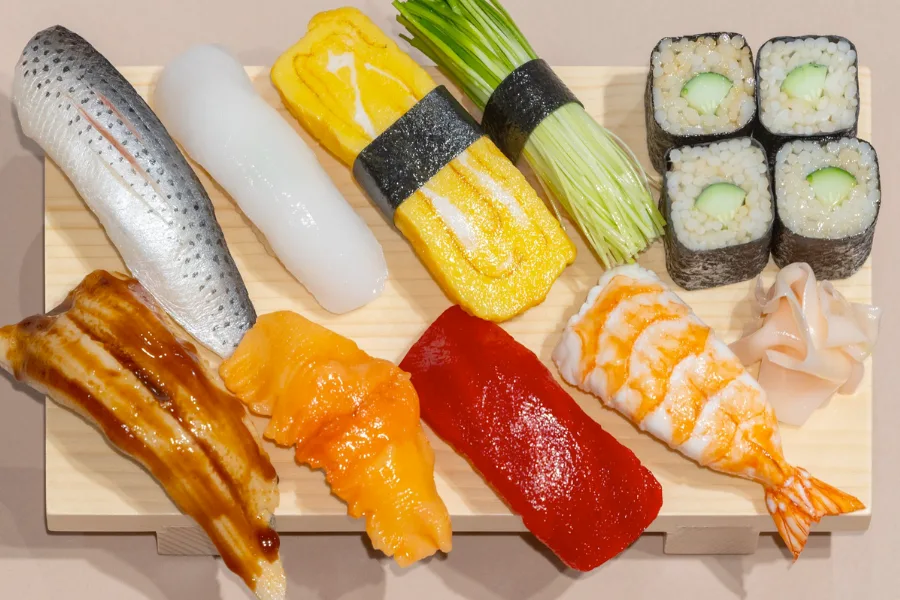
Travellers to Japan often find few things as daunting as a menu written entirely in kanji — particularly when reading Japanese isn’t an option. Cue shokuhin sanpuru — Japan’s hyper-realistic food replicas, a godsend to locals and foreign visitors alike, which have stood in front of restaurants across the country for almost a century. These hyper-realistic food replicas can be created to represent any kind of cuisine for any kind of restaurant, be it distinct cuisines of a region to the colourful drinks and desserts of kissaten coffee shops. This uniquely Japanese fusion of artistry and commercial prowess gives a glimpse into Japan’s dining and food culture and demonstrates how it has developed over time.
Shokuhin Sanpuru
History
For roughly two centuries during the Sakoku period (around 1633 to 1853), Japan operated under strict isolation policies, with foreign contact limited to controlled trade with the Dutch, Chinese, Koreans and Ryukyuans. Movement of people and goods within the country was also tightly regulated. This led to the development of regional cuisines and greater diversity in food culture. Japan’s borders began reopening in the mid-1850s after Commodore Perry’s arrival, with formal trade treaties following from 1854 onwards. The subsequent Meiji Restoration in 1868 accelerated internal movement and the introduction of foods from around the world. By the 1900s, international dishes like croquettes, curry rice, tonkatsu, and sukiyaki became part of the mainstream diet. However, many people were unfamiliar with these foods, making Japanese food replicas essential. Early Japanese food replicas appeared in the early 20th century. They helped diners, especially in department store restaurants, understand unfamiliar Western dishes.
While some artisans had already started making rudimentary food models in the 1920s, Takizo Iwasaki (the father of replica food) was the first to establish a production method that combined accuracy with volume. Iwasaki began experimenting with different techniques, eventually developing a production method using wax and agar jelly moulds. He named his first prototype ‘Kinen Omu’ (Celebration Omelette) since it was based on an omelette his wife had just made at home in their kitchen. He established the Iwasaki Group (Iwasaki Be-I Co.) in 1932, the first company to manufacture food replicas at scale.
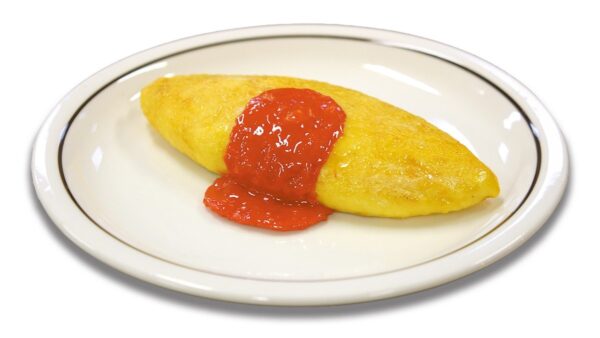
Image credit: Getty
Post-War Boom and Nationwide Adoption
Shokuhin sanpuru became even more popular after the Second World War, when American soldiers and businessmen stationed in Japan struggled to read the menus. They relied on these replica food models to order their food and interact with locals. Department stores and their food markets experienced a renewed boost in popularity, increasingly using food replicas to ease congestion and add beautiful decorations. These replicas then spread from the cities to the countryside as more people started eating out. Skip to the present day and food replicas are now a ubiquitous part of the Japanese landscape. Although much about this industry — estimated at over £75 million globally — has changed, it still remains a fact that every item for restaurant use is custom made by hand just like the first prototypes.


Culture
Shokuhin sanpuru are more than just tools used by restaurants to draw diners in, they are artefacts that showcase Japanese culture. One of the aspects that has shaped Japanese culture is a deep appreciation of the four seasons. Japanese people respect the changing of the seasons and there is a tradition of highlighting seasonal produce in Japanese cuisine. It also means that for every change of the season there is an opportunity to change the food replicas on display in front of restaurants to reflect the change in the dishes.
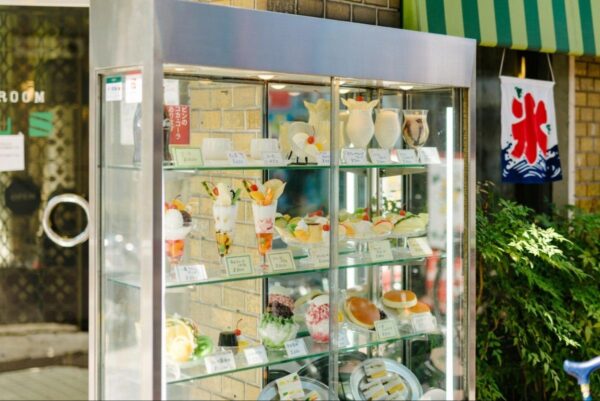
Image credit: Japan House London
Another important aspect of Japanese culture is the concept of Ma (間) which roughly translates to “negative space” or “gap”. It’s a core philosophy that teaches that absence can be as important as presence. This respect for silence and empty space can be found in architecture, music and everyday life. In the past most shops would have noren (a fabric hanging) which would allow potential customers to see into the restaurant without being seen by the people inside. Now what we have to fulfil that role are the shokuhin sanpuru sample cases at the entrance of many restaurants. The sample case allows you to effectively see inside the restaurant by being able to see the food and the prices of the dishes on offer and even gauge the atmosphere of the space. Culturally it is difficult for Japanese people to leave a restaurant without ordering, even if they are unhappy with the menu selection, so it’s important for them to have all the information before they enter. In that sense the display cases with the food replicas are a perfect way of combining the culture of Ma and Japanese psychology.
Function
Shokuhin sanpuru are not just for decoration, they fulfil a number of functions. Firstly they are eye-catching and help people to notice a restaurant. In a sense they work like a sign. They are also appetite-inducing due to their hyper-realistic nature. Small factories across Japan make food replicas to order. They avoid bulk production to ensure the replicas closely match the dishes served at client restaurants. The trick is in striking a balance between realism and aestheticism – the model that looks the most delicious isn’t necessarily the most realistic and the most realistic models might not look all that tasty.
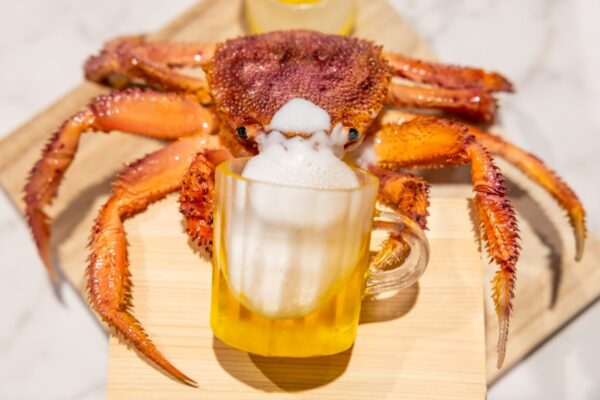
Image credit: Japan House London
Food replicas reassure customers. They show the dish’s size compared to its price and ease nervousness about visiting a new restaurant. They make choosing food fun and entertaining, especially when waiting in a queue. Lastly, they are memorable. The beautiful designs can stick in customers’ minds, even if they didn’t eat that dish, and may inspire a return visit.
Evolution
The four basic steps involved in making shokuhin sanpuru are mould-making, casting, colouring and presentation. Over time, these steps have stayed the same, but the materials have changed: silicone now replaces agar jelly for the mould, and synthetic resin or plastic has replaced wax to create the finished replica. Prompted by increasing demand, these changes have created a product with finer details and greater durability.
Much like the change in materials, the role of food replicas has also grown far beyond its roots. Replicas are now commonplace at high-end confectioners displaying the contents of beautifully packaged omiyage, ‘family restaurant’ chains, izakaya drinking establishments and ramen bars. Anyone who travels on the country’s extensive rail network will also encounter displays of eki-ben at stations as well, helping customers choose which bento option to take on their journey.
Food replicas are also for consumers to simply enjoy however they see fit. There are food replica making experiences and kits that you can buy as well as kitschy gachapon. There are entire shops in Kappabashi dedicated to shokuhin sanpuru where you can buy replicas as souvenirs as well.
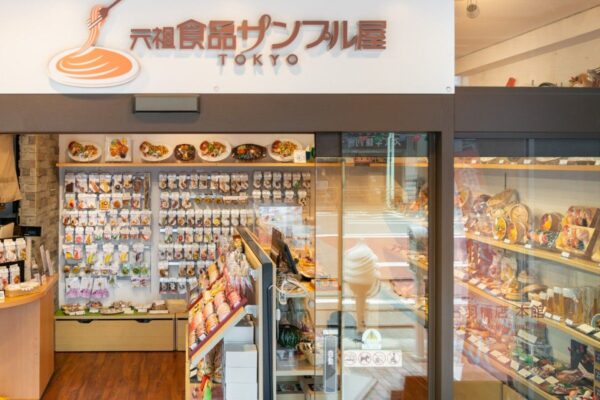
Image credit: Keltie Mechalski
Modern Applications of Food Replicas
Food replicas are now used in a new education system to teach people about their food. Each replica contains an embedded chip, so that when a set of replicas is placed on a special tray the system automatically calculates the meal’s total nutritional value. This method is more realistic than photos, illustrations, or lists. It has proven to be a more effective way to teach nutrition.
Shokuhin sanpuru are also being used in factory settings as well for training and quality control purposes since colour and size are exactly the same as the real product. Food replicas are finally playing a role in health care and academic research. Researchers use these models as controls to represent the original state of experiments that change over time.

Final Thoughts
Shokuhin sanpuru are more than just a practical tool for restaurants – they are true works of art as well as cultural artefacts. They reflect Japan’s commercial ingenuity, dedication to precision and the art of presentation. Whether you’re a food lover, an art enthusiast, or simply curious to learn more, Japan House London previously hosted ‘Looks Delicious! Exploring Japan’s food replica culture‘ (which ran until 16 February 2025), one of the rare opportunities outside Japan to see these models up close alongside displays representing each of Japan’s 47 prefectures.