In 1866, Fyodor Dostoevsky had thirty days to deliver a novel or sign away the rights to his life’s work. Deep in debt and wired on risk, he dictated The Gambler at speed—its sentences breathing with the tempo of the roulette wheel he couldn’t quit. This February (2026), Kyoto’s Chiten Theatre brings that heartbeat to London’s Coronet Theatre, not as a museum piece but as a taut, 75-minute jolt about compulsion, class and the bright logic of losing.
Chiten’s previous visit to The Coronet, GOOD-BYE (2024), sold out in record time, so expect demand.
Led by director Motoi Miura, Chiten dismantles canonical texts and rebuilds them from fragments. Words often arrive late—or not at all—so meaning emerges from rhythm rather than explanation. In The Gambler, that approach lands with a particular bite. Instead of recreating 19th-century Baden-Baden with frock coats and chandeliers, Miura stages a purgatorial casino: light, shadow and sound carve the room, while characters circle one another with the wary alertness of players watching a table turn cold.
The language is Japanese, the surtitles are English, and the real translation happens in your body—the moment a line repeats at a slightly different pitch and you feel the odds change.
The Gambler at The Coronet Theatre
Who is Chiten Theatre?

Photo by Shotaro Ichihashi
Kyoto-based Chiten—chiten means “locus/point”—is a company led by director Motoi Miura that builds productions from collages of existing texts (Shakespeare, Chekhov, Brecht and more). They delay cadence and meaning so you first hear the raw sound of language, then feel sense arrive through rhythm and pattern. The result is lean, musical theatre where form does as much storytelling as plot.
Miura founded Chiten after work with Seinendan and study in Paris; he’s known for precise, actor-led scores and for stripping classics back to breath, beat and stance. Designers and musicians are part of the dramaturgy, not decoration—so here the live band, light and space behave like additional characters at the table.
Chiten’s last visit to The Coronet Theatre, GOOD-BYE (2024), introduced London audiences to this method with kukangendai on stage and a lean, bar-set world drawn from Osamu Dazai. It sold out fast and drew warm notices for its precision and charge. For a recap, see our feature: Beyond Boundaries: Chiten Theatre’s Journey to GOOD-BYE.


A Novel Written in 30 Days
Dostoevsky wrote The Gambler at speed, with everything to lose. The set-up is brutal and simple: Alexei Ivanovich, a tutor, wagers more than he can afford—money, pride, love—while circling an impossible woman and a family hooked on inheritance rumours. The author knew the territory; he was writing to pay the house.
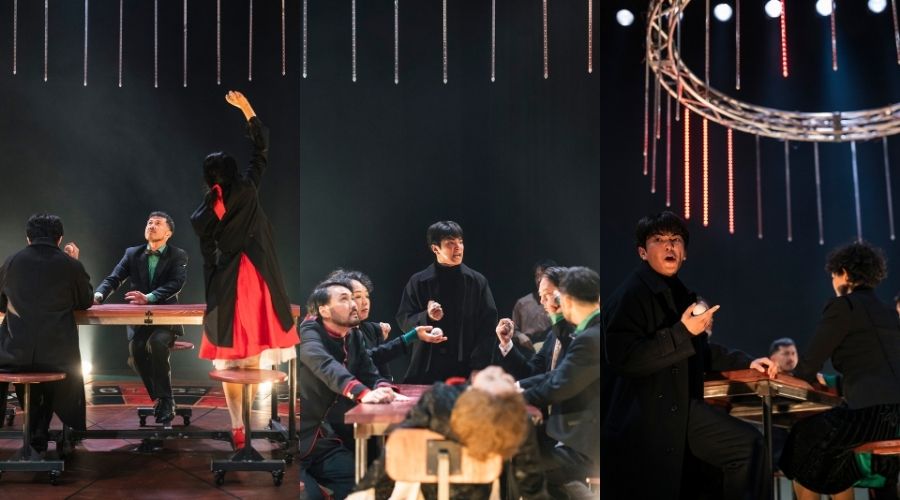
Photo by Shotaro Ichihashi
Chiten doesn’t soften that knowledge with sentiment. They score Alexei’s swings between euphoria and shame as tempo: lines flash by, pauses stretch, a choice lands, then unravels. Because Chiten treats language as sound, the novel’s loop of risk → resolve → relapse becomes audible and physical.
A declaration turns to echo; an echo turns to dare.
“Tomorrow, tomorrow, tomorrow, everything will be settled” reads not as hope but as the gambler’s script for a future that never arrives—and the ensemble’s timing lets you feel that deferral in your body before you read it in the surtitles.
Sound as the table’s hidden dealer
On stage, experimental trio kukangendai play live. The music isn’t background; it drives the odds. Repetition builds pressure, sharp cuts flip the mood, and a quickening bass line stays cool like a player saying they’re fine while their knee won’t stop bouncing.
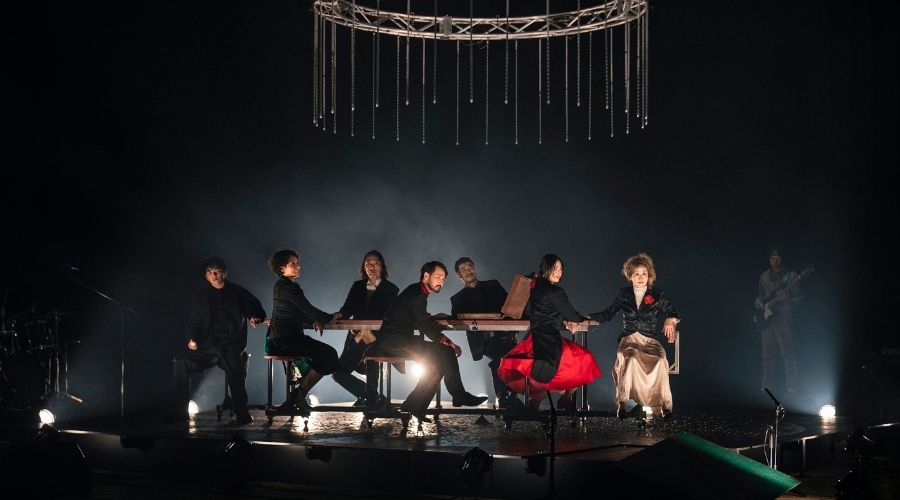
Photo by Shotaro Ichihashi
Often the silence hits hardest: the band drops out, lights hold, and a single breath matters more than any line.
If you’ve never watched theatre with surtitles, this set-up works in your favour. Listen for the meter first—your eye will catch the surtitles in short glances. The piece is designed for that dual attention: the ear for pattern; the eye for meaning. When a phrase shards and returns from a different mouth, you’ll sense the ensemble’s collective voice—the polyphony Dostoevsky wrote, rendered as a physical score.
How Chiten’s stage language lands on the body

Photo by Shotaro Ichihashi
Miura’s collage method—lifting, cutting and re-sequencing text—makes you notice the sound of words before their sense. It’s not abstract for the sake of it. Addiction rarely moves in tidy narrative arcs; it loops. In The Gambler, language loops too. A declaration becomes an echo; an echo becomes a dare. The company’s precision, from breath to footfall, keeps the piece from drifting into haze.
You won’t get a tidy ending. What you’ll feel is the rise in stakes and then the bright emptiness of a bet made a second too late.








What you’ll see (and what you won’t)
There’s nothing nostalgic here. If you’re after a period pageant, look elsewhere. Itaru Sugiyama’s set sketches space rather than spelling it out; Colette Huchard’s costumes and Yasuhiro Fujiwara’s lighting pin status and mood with clean precision. Bunsho Nishikawa’s sound folds band and voices so neatly that a tiny lift in level reads as a shift in power.
The cast, Takahide Akimoto, Midori Aioi, Yohei Kobayashi, Satoko Abe, Dai Ishida, Masaya Kishimoto, Shie Kubota, move with the exactness of musicians counting bars. You’ll see and feel the ensemble thinking together.
Essential event details
- Dates: Thu 5 – Sun 15 February 2026
- Times: 7:30pm performances; Sat 14 Feb additional 2:30pm matinee
- Venue/space: The Coronet Theatre London
- Running time: Approx. 75 minutes, no interval
- Language: Japanese, with English surtitles
- Age guidance: 12+
- Content advisory: depictions of gambling addiction and flashing lights
- Tickets (standard): £60, £50, £40, £30, £20
- Offers: up to 20% off for members, plus concessions and group rates, Nakama readers get 10% off with code CHITENNAKAMA.
- Booking: via The Coronet Theatre’s official website; Chiten’s previous visit sold out quickly!
A Contemporary Reading
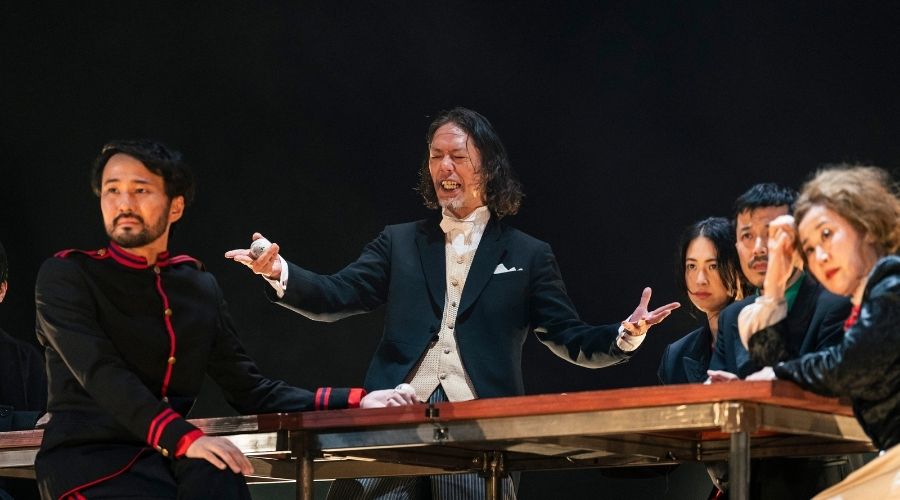
Photo by Shotaro Ichihashi
Today’s bets don’t look like chips; they look like apps, charts and small hits that push you to click again. Chiten’s The Gambler faces that world directly. By dropping period comforts and highlighting pattern, compulsion and delay, it speaks to a culture of deferral—“I’ll stop tomorrow”—and an economy that gamifies attention. It doesn’t preach; it shows you the mechanism, then asks when you start moving to its beat.
That’s the quiet jolt: not simply that Alexei can’t quit, but that tempo can trick anyone into thinking they still choose. In Miura’s hands, Dostoevsky’s wager isn’t a relic; it’s a mirror held to the present. Nakama readers can use code CHITENNAKAMA for a 10% discount.