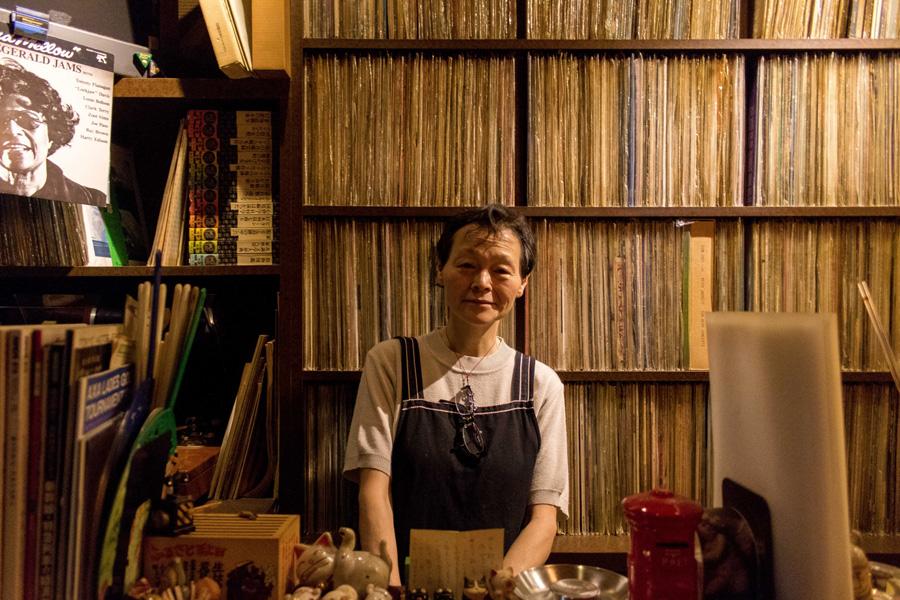
Tokyo Jazz Joints is a photography project by Philip Arneill, made with broadcaster James Catchpole, that has documented Japan’s jazz kissa (jazu kissa, coffee shops built for listening to jazz records) since March 2015. It started in Tokyo, spread across the country, and in 2023 became a book from the German publisher Kehrer Verlag, part funded by a Kickstarter campaign launched in December 2022 for a first print run of 1,500 copies.
Inside Japan's Jazz Kissa
Over 160 jazz kissa photographed since 2015
Starting in the Tokyo Metropolitan area, the project has since expanded to cover the whole of Japan; it has documented over 160 jazz kissa and bars. TOKYO JAZZ JOINTS has an established international audience which intersects vinyl and music enthusiasts, Japanophiles, world travellers, audiophiles and jazz fans.
- To date, images from the project have been shown on 3 continents, including exhibitions in New York, California, Penang, Tokyo, Berlin, Munich, London, Liverpool, Swansea and Belfast
- TOKYO JAZZ JOINTS has been featured in a range of print and online media including The Times, SüdDeutsche Zeitung, The Japan Times, All About Jazz, The Vinyl Factory, Asia Photo Review, Neocha, Wax Poetics & WeJazz Magazine
- An accompanying podcast series of 48 episodes, which places the images in the context of audio and wider Japanese culture, has currently had over 90,000 streams since March 2020.


How jazz reached Japan, from ocean liners to Osaka dance halls


Jazz reached Japan in the 1910s aboard transpacific ocean liners, where Filipino musicians trained in American styles did much to carry it across. The Hatano band, formed in 1912 by graduates of the Tokyo Music School, is sometimes described as the first Japanese jazz band, although it mostly played American dance music. By 1924 Osaka alone had twenty dance halls employing Japanese musicians, and in 1932 trumpeter Fumio Nanri toured the United States, the first Japanese jazz player to be noticed abroad.
During the Second World War jazz was branded enemy music, yet it was too popular for a ban to hold, and many listeners hid their records rather than destroy them. After the war a homegrown scene grew fast. Pianist Toshiko Akiyoshi arrived in Tokyo in 1948, led the Cozy Quartet with a young Sadao Watanabe on saxophone, and in 1956 left to study at Berklee College of Music in Boston. Trumpeter Terumasa Hino and pianist Masabumi Kikuchi followed through the 1960s. The full story is in our guide to the rise of jazz in Japan.
Jazz kissa: Japanese cafés built for listening in silence


Kissaten (喫茶店) is a Japanese-style coffee shop or café. They are typically small and cosy, providing a warm and relaxed atmosphere for people to enjoy coffee, tea, light snacks, and other beverages. Kissaten often have a vintage vibe and may feature antique furniture, decor, and music.
The Japanese word ‘kissa(ten)’ translates directly as ‘tea-drinking shop’. Music cafés first opened in Japan in the late 1920s, and the first one given over entirely to jazz is thought to date from 1929. After emerging fully as jazz kissa in the post-war years, they peaked in the late 1960s and 1970s, when they were often hubs for the counterculture movement and around 600 were trading across Japan. Many have since closed, but the Japanese directory Jazz Kissa Annai still lists them in every region from Hokkaido to Kyushu.
What sets a jazz kissa apart from an ordinary café is the listening. Customers come alone or in pairs and are expected to listen rather than chat. The owner chooses every record, so requests are rare, and the sound system is the centrepiece of the room, often built around large JBL or Altec speakers. Drinks usually cost more than in an ordinary café, which is how a small room of quiet listeners pays its way.
A sacred space with its own ritual and clergy


According to TOKYO JAZZ JOINTS photographer Philip Arneill, the unique environment of the Japanese jazz kissa is a pseudo-religious sacred space, replete with its own ritual, protocol, iconography and clergy.
These sacred spaces are a product of the cultural environment which created them while existing in direct cultural contestation with that same environment; their very existence is a result of their owners’ decision to step outside of Japanese mainstream culture, and it depends on their continued fervour and commitment to keep the faith in an era of changing tastes, digitisation and relentless urban gentrification.
These living museums exist only in Japan and are the subject of increasing attention with the worldwide revival of interest in vinyl, high-end audio equipment and analogue listening spaces.
One of Philip Arneill’s photographs from the project is the image the Barbican chose to promote Haruki Murakami’s Jazz at Peter Cat, a Tokyo listening bar rebuilt on stage in London on 21 November 2026.








Tokyo’s jazz kissa, from more than 250 to around 130


According to James Catchpole, broadcaster and one half of the TOKYO JAZZ JOINTS project, Japanese jazz cafes and bars are often hidden, insular worlds where time ceases to exist, spaces removed from the speed and chaos of the modern urban landscape. Tokyo Jazz Joints is a visual chronicle of this world; an attempt to capture and preserve, if only from the pair’s perspective, the transient beauty of these spaces.
The jazz cafe culture in Japan grew organically in the years after WWII, as venues where fans could gather and listen to the latest records from the United States and Europe. Imported records, let alone turntables and speakers, were a luxury few could afford in those days of recovery from the war. The act of going to a cafe and listening to a new release in a social setting became the norm for a generation of urban Japanese. At its height, areas like Shibuya and Shinjuku in central Tokyo had dozens of these cafes and bars scattered around the main station plazas.
Slowly, the cafes began to disappear as economic development continued and listening to music at home became the norm. Some establishments transformed into night-time-only bars when it was no longer profitable to open for coffee time. Fewer and fewer customers would spend leisurely afternoons immersed in jazz, books and coffee. In 2015 there were approximately 130 jazz cafes and bars spread throughout the Tokyo Metropolitan area alone, a huge number compared to most cities, but down from the peak of more than 250 in the early 1970s.
Year by year, the old jazz joints around town close their doors as the men and women who own them age and their children move on to other more ‘legitimate’ or lucrative occupations. In Catchpole’s words, Tokyo Jazz Joints is an attempt to let people into this slowly vanishing part of Japanese culture. These are small, sometimes tiny, intimate locations where you can lose yourself in the world’s greatest music. When Arneill went back in 2023 to photograph 34 more venues, around 30 of the places the project had documented had already closed.
The Tokyo Jazz Joints book from Kehrer Verlag
The book Kehrer Verlag published in 2023 is a 168 page hardback with an embossed cover and slipcase, carrying 129 colour photographs from the project. It was selected for Rencontres d’Arles 2024 and nominated for the JJA Book Awards 2024, and the standard edition costs €45 direct from the publisher. A Japanese edition from Seigensha followed in 2025, a 176 page paperback titled Tokyo Jazz Joints: 消えゆく文化遺産 ジャズ喫茶を巡る.
Buy Tokyo Jazz Joints from Kehrer Verlag, and take the photographs with you to the kissa that are still open.
Philip Arneill and James Catchpole
Philip Arneill is a Belfast-born photographer, writer and researcher who lived and worked in Japan for two decades. He holds an M.A. Photojournalism & Documentary Photography from the University of the Arts London, was made a Fellow of the Royal Photographic Society in October 2024, and is now a PhD researcher at Belfast School of Art, Ulster University. He is the photographer of TOKYO JAZZ JOINTS.
James Catchpole is a broadcaster and writer based in Yokohama, Japan. He started Tokyo Jazz Site (TJS) in late 2007 to visit and briefly profile every jazz-related establishment in the Greater Tokyo Area. TJS has been featured in publications including the Japan Times, the Asia Wall St. Journal, The Tokyo Journal, BBC Travel, and Smithsonian Magazine, and currently has over 125 jazz joint profiles in its directory. James also hosts the online radio show Tokyo Jazz Map on www.jjazz.net and the OK Jazz Podcast.
The full project can be accessed at www.tokyojazzjoints.com and @tokyojazzjoints on Instagram.