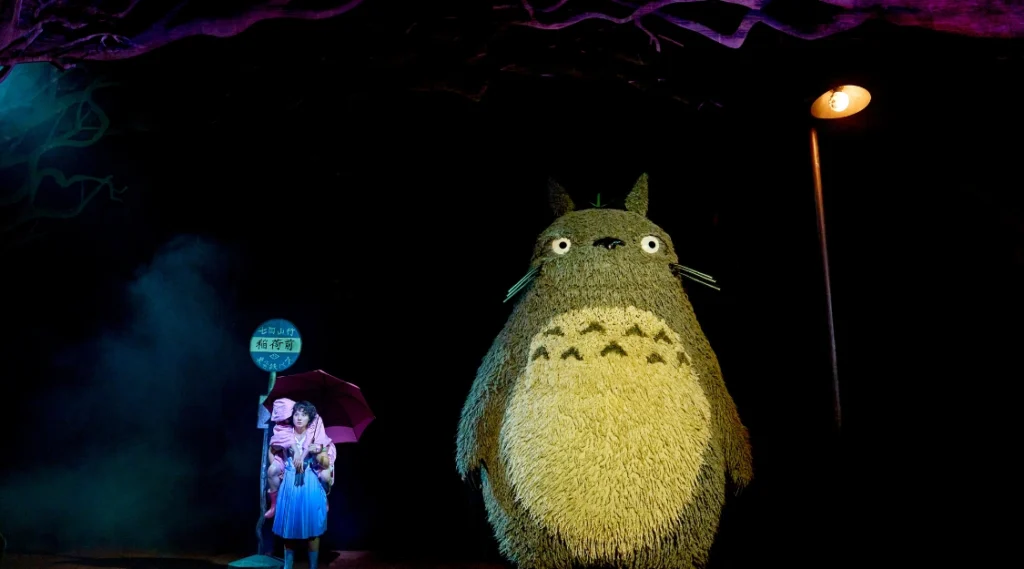
Around halfway into Noda Hideki’s -320 Fahrenheit, in my seat situated right in the middle of Sadlers Wells cosy theatre, I sat utterly baffled by what had thus far unfolded. A man called Help, who is deaf and has a live Japanese Sign Language interpreter, dances in front of a screen of cascading bananas as tests are conducted on his bones. Why? To travel back to ancient times. Through bone conduction, a process where Help’s bones connect with fossils of ancient angels, scientists at the Oolong Cha corporation have thus far succeeded only in going back to the Middle Ages, when Faust, Mephisto and the Pied Piper of Hamelin first cross paths. Following all this?
I strained with my limited Japanese to understand lightning-paced discussions on bones, genes, hell angels, time travel, Faust, God and countless other ideas, or otherwise ping-ponged between the subtitles above the stage and the stunning choreography by Ide Shigehiro. Horio Yukio’s fantastic set design was irresistible, too, and made all its time periods and settings – an ancient palace of a hypercivilized kingdom, a scientist’s laboratory and a Babel-like biotech skyscraper – feel distinct. Actors form gigantic waving bones, transitions between scenes and costumes are flawless, and the sloping space is used with such creativity that you can’t help but feel wonder at how one person thought of so many things to fit into a tight, two-hour show.
Chaos with a Human Heart
For Hideki Noda, dreams, memories and history combine to create a distinctly humanistic performance, exploring the ethical limits of scientific progress and inviting audiences to reflect on the value of human life, while allowing the star-studded cast room to fully inhabit the material. Particularly brilliant is Fukatsu Eri, who plays a princess and a scientist bent on proving her bone-conduction theory to the world in order to create genetically perfect humans.
Abe Sawado as Help also shines as one of the show’s comedic anchors, and props in particular go to the translators and localisers who managed the Herculean feat of allowing us English speakers to get in on his wordplay (for example, DNA and Angels are combined as DNAngel, to match the Japanese 遺天使).
A Powerful Final Act of Empathy
Amidst the chaos and the mayhem is a through-line with deep relevance and profundity. Mephisto, played by Hirose Suzu, suffers from Angel disease, an incurable affliction that slowly turns angels into spiders that roam the world in agony. Stuck between two forces intent on eradicating the disease – the Pied Piper by freezing them to death with-320 Fahrenheit gas, and the biotech company by curing the disease through science – Mephisto is consigned to a fate where she must be changed for the benefit of others to come. But, for Noda, is her existence, however flawed, no enough of an end in itself?
This, Noda explains, is a philosophy inspired by the tragic Sagamihara murders, where a man intent on killing disabled people to ‘save them from unhappiness’ murdered nineteen patients of a care home in Japan in 2016. What right did he have to decide their fate, and why should a disability mean unhappiness, something to be cured?
As the show reaches its end, the satire and comedy fade as this point is underscored. Hirose’s emotive performance consumes the show as she argues her case for a life lived for its own sake. And then, as the show begins to close and the characters move in an expressive dance that combines sign language, the music swells to its climax, and Noda plays one final trick. The sound cuts, plunging the studio into a powerful quiet punctuated only by the sounds of soles stamping on the stage. In this final, radical act of empathy, Noda invites us to experience his world and our own differently, emphasising that this difference is not something to be eradicated, but rather understood.