Note: Japanese names appear in family-name-first order, following art-historical convention.
In this guest essay, filmmaker Amélie Ravalec — director of Japanese Avant-Garde Pioneers — picks three books that capture the spirit of Japan’s 1960s–70s avant-garde art scene.
The 1960s in Japan was a time of profound social change, political unrest, and student protests. The turbulent postwar era inspired an artistic explosion, with the emergence of a revolutionary scene of avant-garde artists who pioneered many disciplines: experimental and erotic photography, “Angura” theatre and underground street performances, apocalyptic Butoh dance, surreal illustrations, and seminal graphic design. These disciplines often intersected, creating a dynamic and multifaceted movement.
This spirit of innovation is central to my film Japanese Avant-Garde Pioneers, which explores the pioneers of this movement and their daring works of art. To celebrate this legacy, I’ve chosen three iconic books that embody the essence of Japan’s avant-garde art and photography. Visionary, provocative, and inspiring, these works offer a window into a period of creative transformation that still resonates today.
Hosoe Eikoh – Barakei – 1963
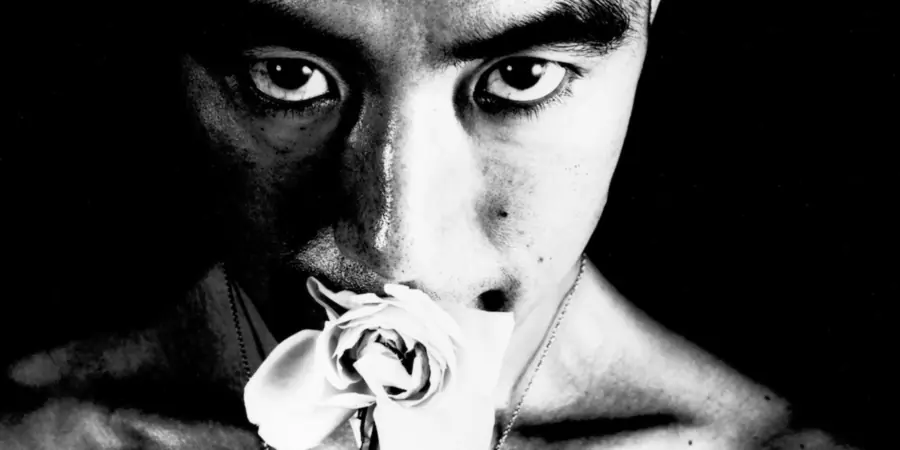
Hosoe Eikoh – Barakei – 1963. ©Hosoe Eikoh: Courtesy of Eikoh Hosoe Photographic Art Institute and Kenji Hosoe
Barakei (“Ordeal by Roses”) is a striking collaboration between photographer Hosoe Eikoh and writer Mishima Yukio, one of Japan’s most provocative literary figures. The book’s imagery delves into the complex, often dark layers of Mishima’s psyche, exploring his obsession with beauty, eroticism, and mortality while showcasing Hosoe’s avant-garde mastery of photographic portraiture.
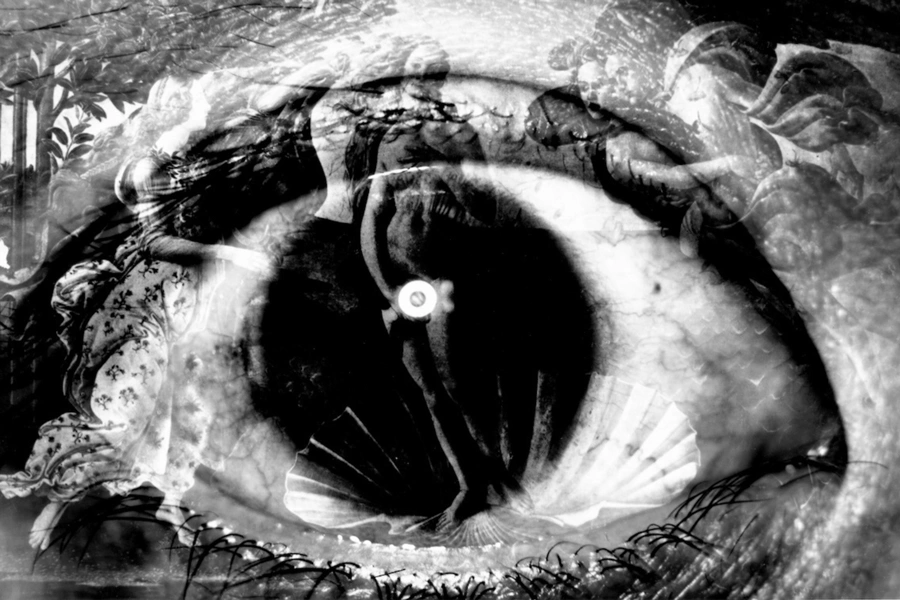
Hosoe Eikoh – Barakei – 1963. ©Hosoe Eikoh: Courtesy of Eikoh Hosoe Photographic Art Institute and Kenji Hosoe
Hosoe pushed Mishima out of his comfort zone, directing him with a boldness that challenged the writer’s sense of control. As Mishima wrote in the preface to Barakei: Ordeal by Roses (1971 revised edition): “The world to which I was abducted under the spell of Hosoe’s lens was abnormal, warped, sarcastic, grotesque, savage, and promiscuous. It was, in a sense, the reverse of the world we live in… Yet in its underground channels, there flowed inexhaustibly a stream of unsullied feeling.”
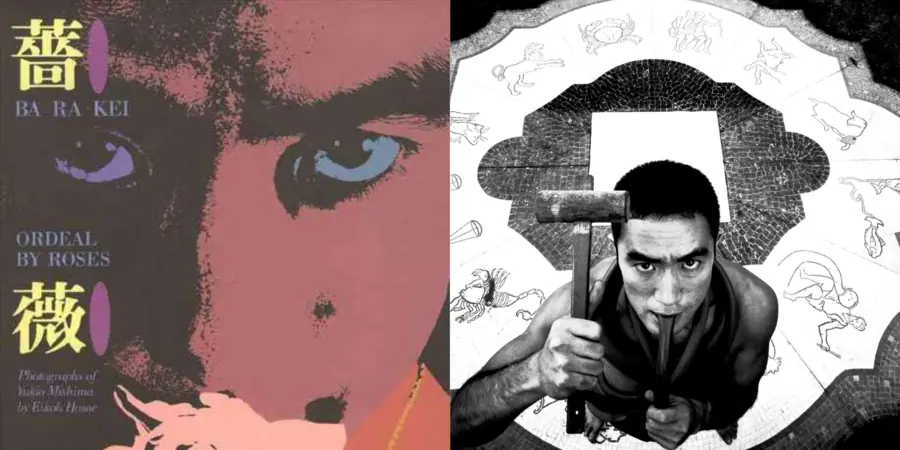
Hosoe Eikoh – Barakei – 1963. ©Hosoe Eikoh: Courtesy of Eikoh Hosoe Photographic Art Institute and Kenji Hosoe
The resulting images are raw, surreal, and deeply visceral. The book’s title, chosen by Mishima himself from a list of ten options he provided, reflects his poetic vision and penchant for dramatic symbolism. Today, Barakei remains a seminal work in Japanese photography and a vivid testament to the era’s avant-garde spirit.
Terayama Shūji – Photothèque imaginaire de Shūji Terayama – Les gens de la famille Chien-Dieu – 1975
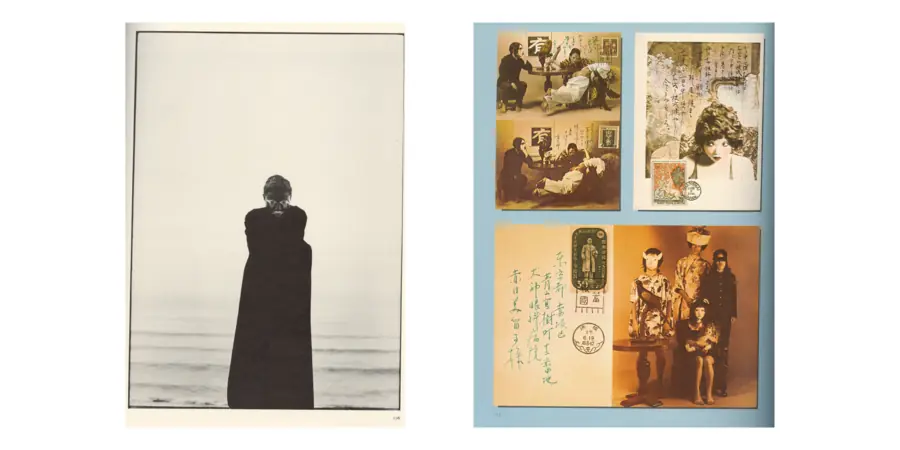
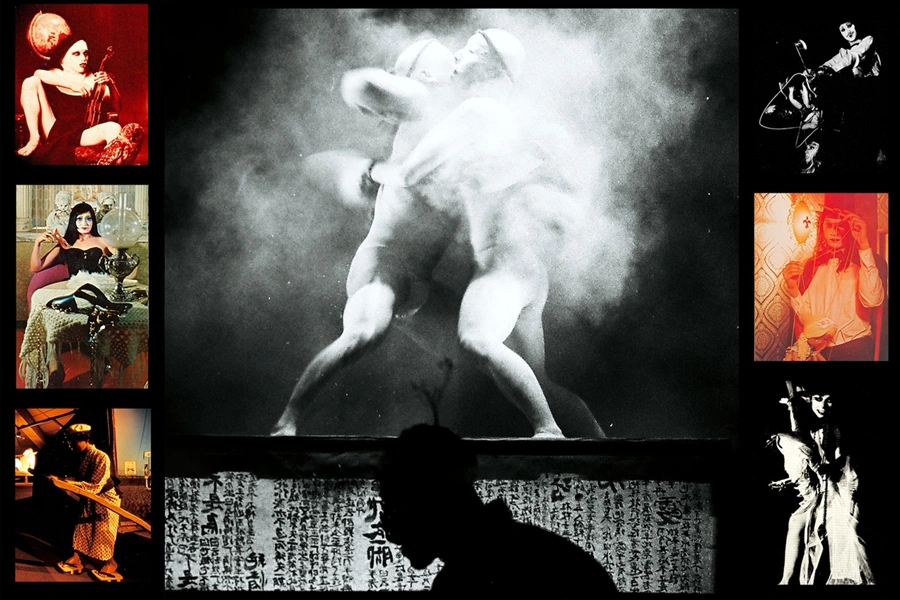
Terayama Shūji – Photothèque imaginaire de Shūji Terayama – Les gens de la famille Chien-Dieu – 1975. © Terayama Shūji: Courtesy of Sasame Hiroyuki, Terayama World Co.
Few artists embodied the avant-garde ethos as fully as Terayama Shūji, whose practice moved freely between theatre, film, poetry and photography. Few artists embodied the avant-garde ethos as completely as Photothèque imaginaire de Shūji Terayama – Les gens de la famille Chien-Dieu (1975) represents Terayama’s unique ability to merge surrealism with deeply personal narratives. His work is steeped in the theatricality that defined his revolutionary theatre group, Tenjō Sajiki, known for its eccentric, dreamlike productions that blurred the lines between performance, reality, and imagination.
Terayama’s photography reflects his fascination with illusion and truth, a theme central to his creative philosophy. Inspired by his extensive reading of European surrealists such as Antonin Artaud, Georges Bataille, and Lautréamont, as well as encounters with Salvador Dalí, Terayama infused his work with a dreamlike quality where the boundaries between reality and fantasy dissolve. This photobook incorporates staged and fake family portraits, combining fantastical costumes with imagined narratives, creating an uncanny effect that challenges the viewer’s perceptions.
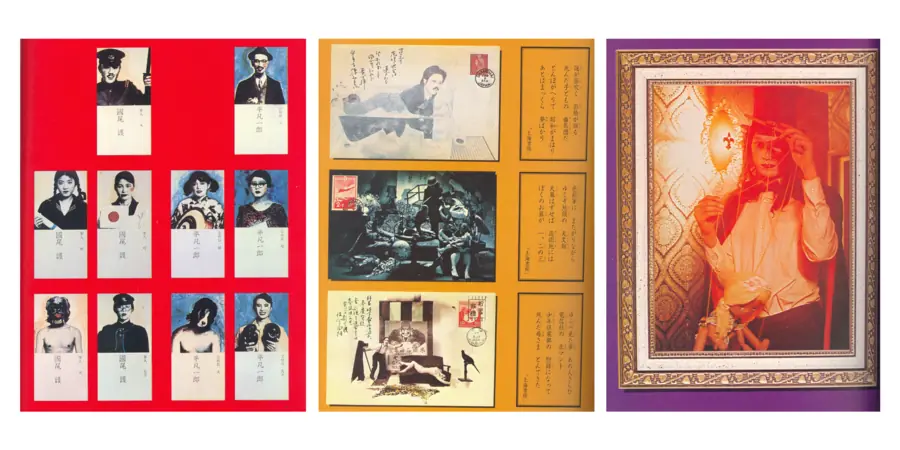
Terayama Shūji – Photothèque imaginaire de Shūji Terayama – Les gens de la famille Chien-Dieu – 1975. © Terayama Shūji: Courtesy of Sasame Hiroyuki, Terayama World Co.
Terayama’s belief in art as a tool for social change is evident in his provocative, often scandalous creations. As Terayama famously asserted, “A play which isn’t scandalous cannot reform reality.” His works addressed themes of marginalisation and prejudice, focusing on outsiders, including LGBTQ+ individuals and other marginalised groups. By portraying unconventional characters in his art and theatre, Terayama questioned societal norms and highlighted the absurdity of discrimination.
Photothèque imaginaire is a perfect introduction to the world of Terayama, where reality and imagination collide to provoke and inspire. Its exploration of the bizarre and grotesque opens a window into a universe that is deeply unsettling yet profoundly human, making it a quintessential embodiment of Japan’s avant-garde movement.


Kawada Kikuji – The Map – 1965
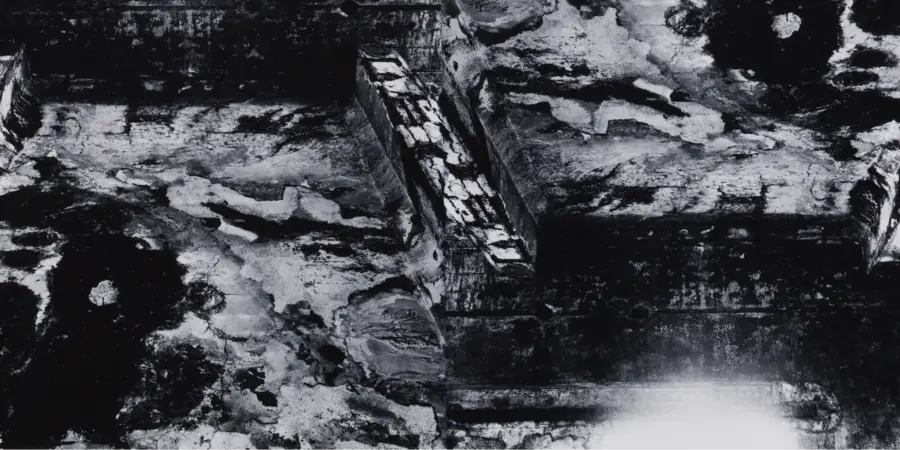
Kawada Kikuji – Stain on the dome’s ceiling – 1965) ©Kawada Kikuji: Courtesy of PGI
Kawada Kikuji’s The Map (Chizu), published in 1965, is widely regarded as one of the most important photobooks of the 20th century. This groundbreaking work, designed by Sugiura Kōhei, took five years to complete and remains a masterpiece of photographic storytelling and design. Kawada’s photographs span a range of subjects, from close-ups of the Hiroshima Atomic Dome’s basement to everyday objects like Coca-Cola bottles and the national flag. Together, these images form a haunting exploration of Japan’s postwar identity, national scars, and its uneasy relationship with modernity and the United States.

Kawada Kikuji – Medals and Orders of Ninety-Year-Old Japanese – 1965. ©Kawada Kikuji: Courtesy of PGI
The book’s structure itself is a marvel, a layered, tactile experience that transcends the traditional photobook format. Its spreads unfold, inviting viewers into a deeply unsettling yet beautiful world. Kawada divided the book into three sections: Japanese soldiers and the remnants of military fortresses, the scars of Hiroshima, and the detritus of Japan’s rapid economic growth.
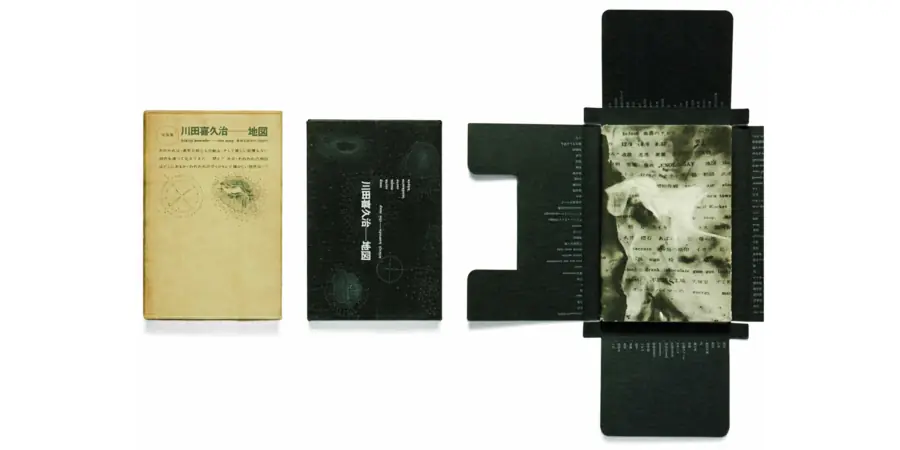
Kawada Kikuji – Chizu (The Map) – 1965. ©Kawada Kikuji: Courtesy of PGI
A pivotal moment in The Map is Kawada’s discovery of a stain in the basement of the Atomic Bomb Dome. He recalls how the eerie, amoeba-like patterns seemed to proliferate before his eyes, reflecting the horror and sublimity of the postwar experience. These photographs capture a sublime beauty, where the terrifying and the beautiful coexist, offering a stark reminder of the fragility and resilience of humanity.
Today, the photobook is celebrated not only for its visual power but also for its ability to articulate the unspoken truths of a nation grappling with its past. Kawada’s genius lies in his ability to transform abandoned monochromes and discarded objects into profound symbols of history, identity, and memory.
The Map serves as a powerful reminder of the transformative potential of photography. It transcends documentation, functioning as both a work of art and a historical reckoning, making Kawada Kikuji a true avant-garde visionary of his time.
The Enduring Legacy of Japan’s Avant-Garde Movement
These three books capture the essence of Japan’s avant-garde movement, each reflecting a unique facet of its fearless creativity. Through their distinctive visions, Hosoe Eikoh, Terayama Shūji and Kawada Kikuji challenged societal norms, redefined their mediums, and left behind works that continue to provoke, inspire, and resonate today. I hope this will inspire you to delve further into the fascinating world of the Japanese avant-garde.
Japanese Avant-Garde Pioneers
Author’s note: The author is the director of Japanese Avant-Garde Pioneers.
My film, Japanese Avant-Garde Pioneers, is a tribute to this revolutionary period, featuring over 600 works of art that bring the era’s bold spirit to life. Through rare archives, in-depth interviews, and an exploration of the lives and works of these groundbreaking artists, the film offers an immersive look at the cultural upheaval and artistic innovation that shaped Japan’s avant-garde movement.
The film premiered in spring 2025 and has since screened at art-house cinemas, museums, festivals and cultural institutions internationally.
Directed by Amélie Ravalec
Produced by Circle Time Studio
Co-produced by Whatsopp. Inc. / Maaserhit Honda
Released: 2025
References
- Sorgenfrei, C. F. (2005). Unspeakable Acts: The Avant-Garde Theatre of Terayama Shuji and Postwar Japan. University of Hawai’i Press. http://www.jstor.org/stable/j.ctt6wqhj0