Hollywood is known to rip off stories, but when it comes to Japanese cinema, it’s in a league of its own. Japan has given Hollywood some of the best movies in the past few decades. From blockbusters like The Ring and Godzilla, to cult classics like Battle Royale, you can see that Hollywood wouldn’t be what it is without Japan.
The Japanese film industry has been thriving for more than 100 years now. …or do they? Beneath the highly acclaimed films we know and love lies a Japanese movie that inspired Hollywood, enthralled award-winning filmmakers and impacted their scripts.
Here are our top 10 picks for the best Japanese movies that Hollywood has ever seen!
Japanese Movies that Inspired Hollywood
Inception and Paprika
Did you know that Inception, Christopher Nolan’s mind-bending movie is actually almost a direct copy of the 2006 Satoshi Kon masterpiece Paprika? Conceptually, both take a literal deep dive into the characters’ dreams, blurring the line between the two.
Both Inception & Paprika show the characters breaking into each others’ dreams, delving deeper and deeper using a machine created in order to positively or negatively influence the victim.
Like-for-like scenes are also seemingly visible, as in Paprika, a man is seen falling midway through a distorted hallway, while one of the most popular scenes in Inception is a fight in a hotel hallway with an ever-changing perspective. Nolan has actually praised Paprika itself in the past, so take that information how you will.



Requiem for a Dream/Black Swan and Perfect Blue
Satoshi Kon has definitely made an impact on some of the most renowned filmmakers of our time, as his 1997 classic Perfect Blue has influenced two of Darren Aronofsky’s films. Perfect Blue is a disturbing look into the life of an idol, whose abrupt career change has led to an obsessed fan impersonating her, making her slowly lose her identity.
Comparing this to Black Swan, Nina (whose name is suspiciously similar to that of Mima, the main character of the aforementioned Perfect Blue) is also a young, beautiful woman who works in the entertainment industry as a ballerina. Both have similar attitudes and goals in their careers, hoping to make it big while both being managed by an older male figure, both of which emphasise personal gain over the goals of their young performers.
In Requiem for a Dream, Aronofsky was rumoured to have bought the American filming rights to Perfect Blue so that he could film the bathtub scene in it. Aronofsky has stated multiple times that although Satoshi Kon is a big influence and inspiration to his films, they are not copies, despite the fact that he’s recreated a like-for-like shot in his movie. Again, take this how you will.
The Hunger Games and Battle Royale
Being the progenitor of the death game formula, Battle Royale influenced many mediums with the one versus one hundred formula. The Hunger Games has been criticised in the past for being overly similar to the much-loved student gorefest that is Battle Royale, but author Suzanne Collins has vehemently denied claims about the direct inspiration.
Both movies have the exact premise of placing multiple kids in a deserted area in a kill-or-be-killed scenario where only one person survives and or wins the tournament. On top of this, The Hunger Games also features the element of romance present in Battle Royale, where the main hero and heroine help each other triumph through the craziness around them with teamwork, making some friends along the way to aid them into succeeding.
Kill Bill and Lady Snowblood
Continuing the gory theme of survival through murder are the two assassin flicks Kill Bill and Lady Snowblood.
In Lady Snowblood, Yuki, a child born through sexual assault trains to be an assassin to avenge the evil done to her mother.
In Kill Bill, the main character known as The Bride looks to seek revenge against Bill, who attempted to kill The Bride after she left him while pregnant with his child. Although not entirely similar in plot, both mainly involve heroines who were forced off the beaten path by the main antagonist who they resolve to take revenge against.

The Matrix and Ghost in the Shell
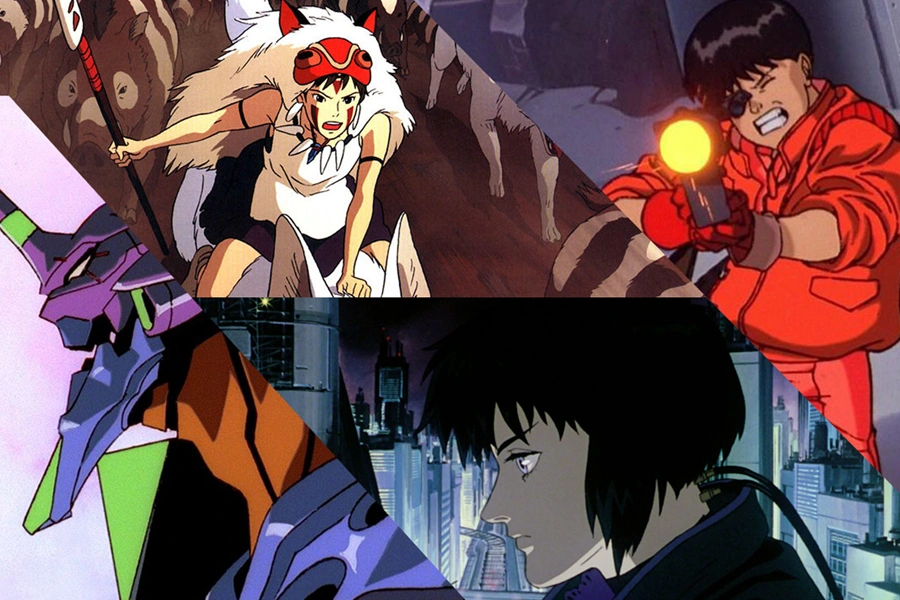
So far, all the creators mentioned above have denied their Japanese influences. On the other hand, the Wachowski sisters, a pair of minds behind the Matrix & Animatrix movies fully embrace the influence of their multiple award-winning sci-fi mind-bender.
It is widely publicised that the sisters even showed a copy of Ghost in the Shell to the producers as part of their pitch for The Matrix. Style-wise, both movies are as similar as they come, with killer cyberpunk action sequences and fight choreography abound.
The story is also heavily influenced, as both movies deal with machines gaining consciousness and discovering what it means to be alive. Heck, even the extremely popular green matrix screen is originally taken straight from Ghost in the Shell. Feel free to take the blue pill if you’re in denial as to the similarities between these two films.
Avatar and Princess Mononoke

Next on our list is a pair of films that both have the central plot of nature defending itself from humans who look to benefit. In Avatar, the earth has become close to uninhabitable due to precious resources being taken from forests at will.
The main characters are tasked with finding a new energy source, which is only present to a village of blue creatures who use it as their own living habitat.
Likewise, in Princess Mononoke, the characters are also tasked with defending their territory from humans who continue to clear and deplete their resources for their own personal good.
Although it has also been compared to other films such as Pocahontas and FernGully, Avatar has been mainly compared to the Miyazaki classic, as even Cameron himself has stated it as a major inspiration to his work.
Pacific Rim and Neon Genesis Evangelion
There are more similarities that these two giant-robot-versus-monster action flicks have than you think. Not only are they similar from the standpoint of a conceptual eye test, but a lot of qualities from both protagonists and antagonists are too.
Both films feature a main male character with emotional trauma, a blue-haired femme fatale who falls in love with and willingly puts their life on the line for him, and robots that are controlled through mental links and consciousness.
Plot-wise though, these two films are quite different in nature. Pacific Rim is more of a popcorn action film with plentiful explosions whereas Evangelion focuses more on the existential side of its characters, finding light through their dark pasts. Regardless, you can definitely see similarities in its main quality of large mecha fights.
Chronicle and Akira

What would you do if one day you randomly woke up with psychic powers? This is the main theme encompassing both of these movies, as both feature young boys who randomly gain Psychic and Telekinetic Powers. Both of these films explore the potency and extent to which power can corrupt even the most innocent of minds.
What differentiates Chronicle from the Japanese classic is the way it presents this idea, as it is shot from the first-person, found-footage point of view. The main character, Andrew, films their psychic lives with a camcorder, adding realism and immersion to the overall experience. What first masquerades itself into a superhero origin story turns awry and dark after it presents the dark ways such power can be abused.
The main character Andrew draws a striking resemblance to Tetsuo Shima, the main protagonist and psychic user in Akira, and there’s even a scene from Chronicle that looks like it was directly inspired by it. Given all this, it’s not surprising that director Josh Trank names Akira as one of his favourite films, citing it as a big influence on his teenage power fantasy story.
The Hidden Fortress/Throne of Blood and Star Wars
George Lucas has been known to openly praise legendary Japanese director Akira Kurosawa, hailing him as one of the primary influences for the global phenomenon that is Star Wars. Two of his films come up most often when fans trace the space epic back to Japan, though only one is a source Lucas has named himself.
Throne of Blood (1957), Kurosawa’s retelling of Macbeth, is a fan comparison with the prequel trilogy. Washizu kills his lord after a forest spirit foretells his rise, and Anakin turns on the Jedi after visions of Padmé’s death. Lucas has never named it as a source, so treat this one as a reading of the films.
The Hidden Fortress (1958), on the other hand, is the Kurosawa film Lucas has named most often as a source for the original Star Wars. It tells its story through two bickering peasants, the model for C-3PO and R2-D2, and follows a general escorting a defiant princess through enemy territory, much as Luke, Han and Obi-Wan rescue Princess Leia in A New Hope.
It isn’t a surprise how strikingly similar these plot points are, given the massive respect Lucas has for Kurosawa.
Final words
All these are great examples of how Japanese pop culture has been a massive influence on huge blockbusters and cult classics in the west. Watching these Japanese inspirations are great ways to see the humble origins of your favourite franchises. It will not be a surprise if many more directors turn to Japanese classics if they seek inspiration for their next mega-hit.