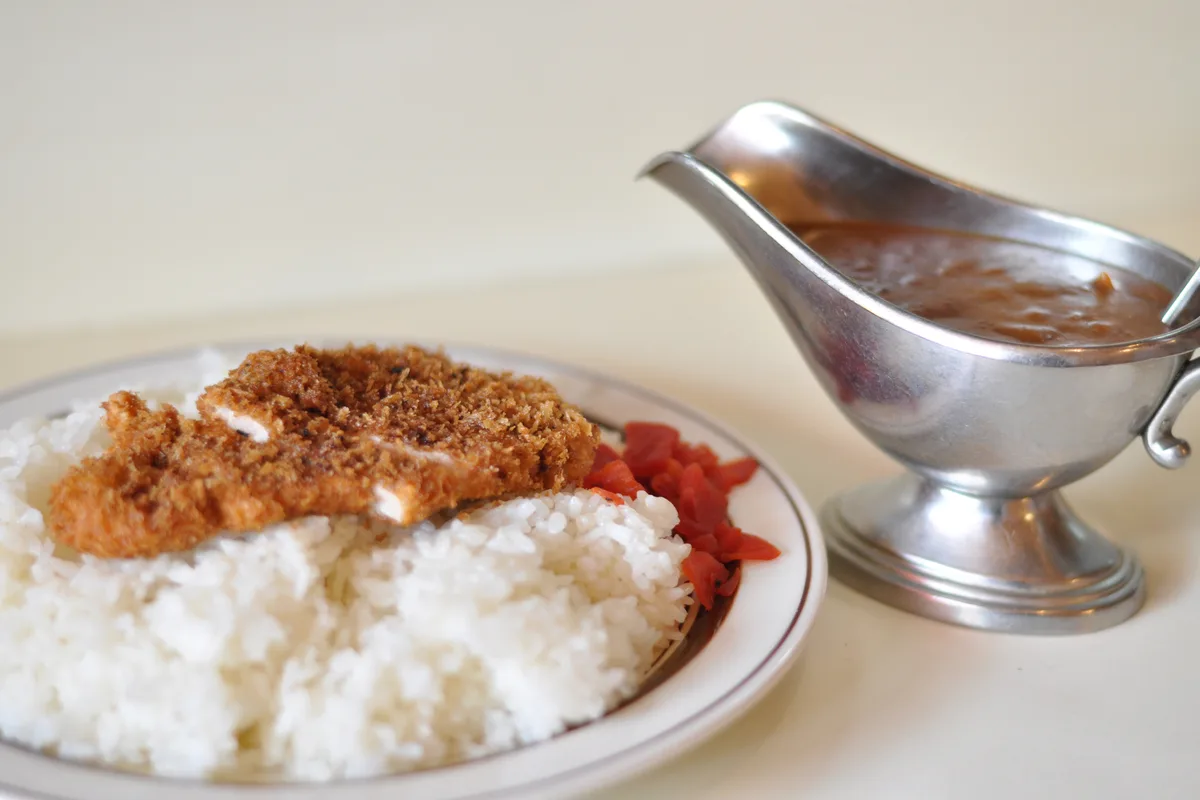
Katsu curry is a breaded, deep-fried cutlet served with rice and Japanese curry sauce, and the best-known story of its invention places it at Ginza Swiss, a Tokyo restaurant, in 1948. It reached Britain through Wagamama, which had katsu curry on the menu when its first restaurant opened in Bloomsbury in 1992, according to the Japan External Trade Organization (JETRO).
Both halves of the dish came to Japan from the West. This guide traces each one, the rival claims to the first katsu curry and how “katsu” came to mean a sauce in British shops, then gives a short home method and the London places that serve it the Japanese way.
Katsu curry at a glance
What it is: a breaded cutlet (katsu) with Japanese curry and rice, usually pork in Japan and chicken in the UK.
What katsu means: cutlet, from katsuretsu, the Japanese rendering of the English word.
Curry in Japan: arrived from Britain in the Meiji era, with recipes in print by 1872.
The first katsu curry: Ginza Swiss in 1948 is the best-known claim; Kawakin in Asakusa dates its version to 1918.
In the UK: on Wagamama’s menu from its opening in 1992.
Katsu Curry History, From Ginza to the UK
What Katsu Curry Is: A Breaded Cutlet on Japanese Curry Rice
The word katsu is short for katsuretsu (カツレツ), the Japanese way of saying cutlet, and in Japan it means the fried, breadcrumbed meat itself. Japanese curry, karē, is a thick stew of meat, onion, carrot and potato, thickened with a roux and spooned over rice as karē raisu, or curry rice. Put a cutlet on that plate and you have katsu karē, the dish British menus call katsu curry.
The Embassy of Japan in France describes Japanese curry rice as a dish that came from Britain and reached family kitchens through soldiers who ate it in the army. The cutlet on top is a European idea that Tokyo cooks adapted in the 1890s.


Curry Reaches Meiji Japan From Britain in the 1870s
Curry arrived in Japan as a British dish, made with British curry powder, after the country opened to the West in the Meiji era (1868 to 1912). In 1872, the fifth year of Meiji, two Western cookery books, Seiyō Ryōri Shinan and Seiyō Ryōri Tsū, printed recipes for a dish made with curry powder and thickened with flour, according to the Embassy of Japan in France. Flour still gives Japanese curry its thick body today, because it is the base of every roux block.
Within a few years curry had reached the provinces. The traveller Isabella Bird, stopping at an inn in Kubota, the capital of Akita Prefecture, in July 1878, was relieved to be served “foreign food”: “a good beef-steak, an excellent curry, cucumbers, and foreign salt and mustard” (Unbeaten Tracks in Japan, 1880, Letter XXI).
The Navy Curry Story in Yokosuka
The best-known chapter of the story belongs to the navy. In the account published by the Consulate General of Japan in New York, drawing on Japan’s Ministry of Agriculture, Forestry and Fisheries, the Imperial Japanese Navy’s diet of white rice left sailors short of vitamins and suffering from beriberi. The navy adopted the meat and vegetable curry that the British navy was eating at the time, which was really a curry-flavoured stew, and cases of beriberi fell sharply.
Yokosuka, the naval port south of Tokyo, sells Yokosuka Navy Curry, which follows the recipe in the navy’s 1908 cookery reference book, the Kaigun Kappōjutsu Sankōsho, and the same account says navy curry spread across Japan from the city. Treat the navy as one route among several: the Embassy of Japan in France credits the army as well, and Isabella Bird was eating curry at a provincial inn 30 years before the navy’s cookery book was printed.
From S&B’s 1923 Curry Powder to the Curry Roux Block
For decades most of the curry powder used in Japan was imported. When a young spice blender, Yamazaki Minejirō, succeeded in making his own blend in 1923, he opened a shop in Asakusa in Tokyo and priced his curry powder 5 sen below the British brand C&B, according to S&B Foods’ company history. That business became S&B, which still dates its founding to the year of that first blend.
The bigger change came with the roux block, a solid slab of flour, fat and curry spices that melts into a pan of simmering meat and vegetables. Instant curry products came onto the market from about 1952, and S&B launched its own solid instant curry in 1954, once it could buy good-quality flour. House Foods brought out its first solid roux in 1960, and one of its managers has said plainly that it was not Japan’s first. Who came first is disputed: the Embassy of Japan in France dates the first solid curry roux to 1950.
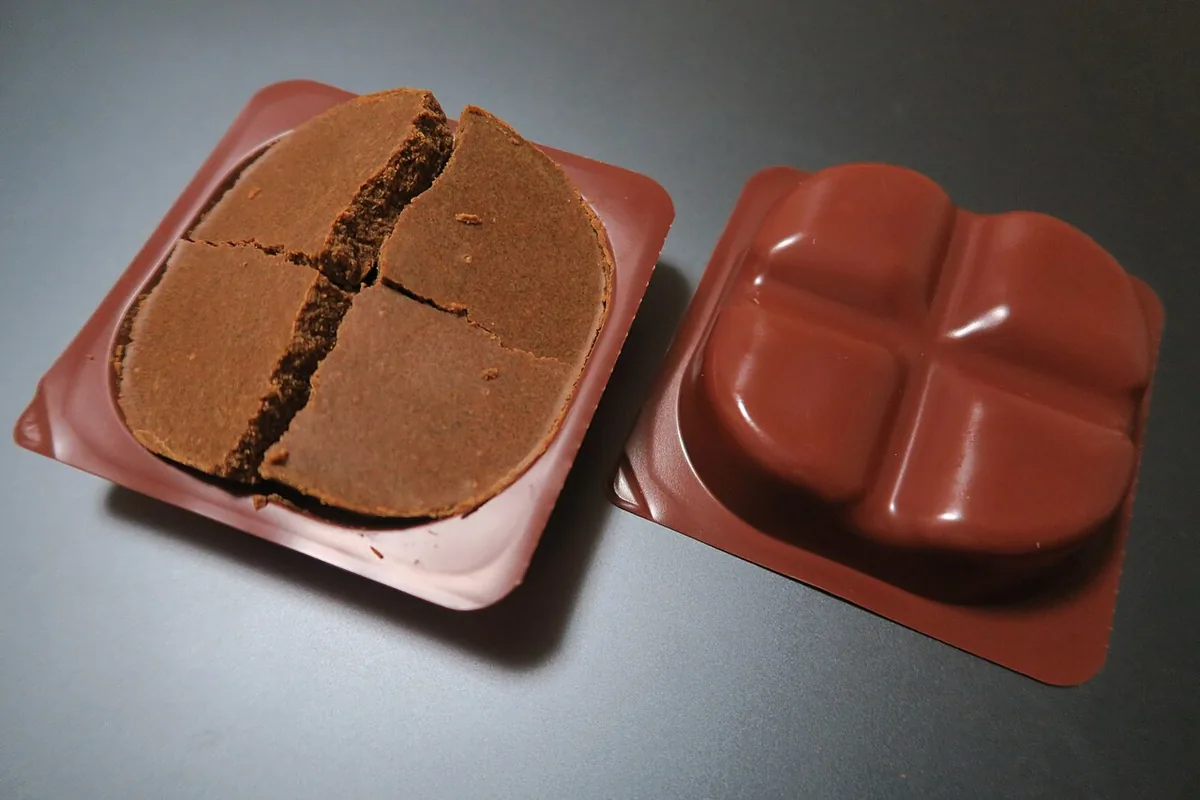
House’s Vermont Curry followed in 1963, made mild so that children could eat curry with their parents, and House describes it as a standard brand everyone in Japan knows. In London, boxes of curry roux sit on the shelves of Japanese grocers such as Rice Wine Shop on Brewer Street in Soho, and our guide to Japanese supermarkets in London lists the rest.
Rengatei’s Pork Cutlet, Ginza, 1895
The cutlet came from Europe as a thin slice of veal, floured and fried in a little fat, and Japanese cooks called it katsuretsu. The pork version is usually traced to Rengatei, a Western-style restaurant that opened in Ginza in 1895 and still serves what it calls its original pork cutlet. Rengatei is also credited with the pile of shredded cabbage that comes with a cutlet in Japan to this day.
By 1901 cutlets were ordinary restaurant fare in Tokyo. The English writer Osman Edwards ate “delicious shrimp-cutlets” at the Isemon restaurant in Asakusa before an evening of storytelling (Japanese Plays and Playfellows, 1901). The name tonkatsu, from ton for pork and katsu, came later. One widely repeated account credits Shimada Shinjirō, a former cook in the Imperial Household kitchens, with a thick pork cutlet he served under that name at Ponchiken in Ueno in 1929, though the origin of the word is still debated.



Ginza Swiss, 1948, and Two Older Claims to the First Katsu Curry
The story most people know starts in 1948 at Ginza Swiss, a Western-style restaurant that first opened in Ginza in 1947. A regular customer, the Yomiuri Giants baseball player Chiba Shigeru (1919 to 2002), asked for a pork cutlet on his curry rice, and the restaurant has served it ever since. The curry writer who goes by the name Curry Cell gives the exact date as 14 August 1948, in nippon.com’s guide to katsu curry.
The claim even appears in an official programme: a spring 2026 katsu curry event at Ginza Swiss’s Tsukiji branch, listed among the Cabinet Secretariat’s projects for the 100th year of the Shōwa era, billed the restaurant as the birthplace of katsu curry.
Two older restaurants have claims of their own. Kawakin in Asakusa dates its cutlet-and-curry bowl, which it calls Kawakin-don, to 1918, and Ōroji in Shinjuku dates its tondon to 1921, as Tokyo Updates, the Tokyo Metropolitan Government’s English magazine, reported in 2025. Kawakin’s owner, Yoshikazu Kono, says it never called the dish katsu karē but is the oldest of the restaurants still standing. Ginza Swiss’s owner, Akemi Fujioka, is relaxed about it: “No one has any proof, and we’ve never once fought over it.”
Katsu Curry Timeline, From 1872 Cookbooks to the 2024 Greggs Bake
| Year | What happened | Source |
|---|---|---|
| 1872 | Two Western cookery books print recipes for curry thickened with flour | Embassy of Japan in France |
| 1878 | Isabella Bird is served “an excellent curry” at an inn in Kubota, Akita | Unbeaten Tracks in Japan (1880) |
| 1895 | Rengatei opens in Ginza and serves a pork cutlet | LIVE JAPAN; GOOD LUCK TRIP |
| 1908 | The navy’s cookery reference book prints the curry recipe Yokosuka still follows | Ministry of Agriculture, Forestry and Fisheries, via the Consulate General of Japan in New York |
| 1918 | Kawakin in Asakusa dates its cutlet-and-curry bowl to this year | Tokyo Metropolitan Government |
| 1923 | Yamazaki Minejirō blends his own curry powder and founds what becomes S&B Foods | S&B Foods |
| 1948 | Ginza Swiss serves a pork cutlet on curry rice for the baseball player Chiba Shigeru | Tokyo Metropolitan Government; Cabinet Secretariat |
| 1954 | S&B launches its solid instant curry | S&B Foods |
| 1963 | House Foods launches Vermont Curry | House Foods |
| 1992 | Wagamama opens in Bloomsbury, London, with katsu curry on the menu | JETRO; The Guardian |
| 2014 | Tesco launches a Katsu Curry Meal Kit in May | The Grocer |
| 2016 | Wagamama’s chicken katsu curry is ordered 2.5 million times | The Guardian |
| 2020 | Hiden opens its Japanese curry lab at Coal Drops Yard, King’s Cross | Hiden |
| 2023 | New UK products with katsu in them reach 26 a year, up from seven in 2020 | Mintel, via Ingredients Network |
| 2024 | Greggs launches its Katsu Chicken Bake in July | Mintel, via Ingredients Network |
How Katsu Curry Became a UK Staple, Starting at Wagamama in 1992
Wagamama put katsu curry in front of British diners. Alan Yau opened the first Wagamama in Bloomsbury in 1992, and JETRO’s history of katsu curry in the UK reports that the dish was on its opening menu. By 2016 chicken katsu curry was the chain’s most popular dish, ordered 2.5 million times that year, and Wagamama’s executive chef, Steve Mangleshot, explained its appeal to The Guardian in four words: “It doesn’t scare people.”
Curry Cell credits Wagamama with starting the British boom, and points to two changes the dish made on the way. Chicken replaced pork, out of respect for religious dietary rules, and diners are often offered potatoes in place of rice. Wagamama’s own version pairs panko-coated chicken with sticky rice and salad.
Supermarkets followed the restaurants. Tesco launched a Katsu Curry Meal Kit in May 2014 at £2.49 for 440g, and the trade magazine The Grocer credited Wagamama and the Wasabi chain with making shoppers aware of the dish. In Mintel’s database of new products, UK launches with katsu in them rose from seven in 2020 to 26 in 2023. Burger King added katsu burgers in 2022, and Greggs launched a Katsu Chicken Bake in July 2024. JETRO adds that S&B Foods now counts the UK as its largest market in Europe.
Why “Katsu” Means the Sauce in British Shops
Somewhere along the way the word moved from the cutlet to the sauce. JETRO notes that in the UK “katsu” is now used as the name of a sweet, curry-flavoured sauce, and supermarket shelves carry katsu curry sauces and pastes with no cutlet in sight.
Japanese social media noticed in January 2020, when users began posting under the hashtag #KatsuCurryPolice. They pointed to a chicken katsu curry soup at Pret and to curry sauces sold in British supermarkets as katsu curry. To a Japanese cook, katsu curry is curry with a katsu, a cutlet fried in panko breadcrumbs; without the cutlet, it is simply karē, or karē raisu when it comes with rice.
UK Katsu Curry and Japanese Katsu Karē Compared
The two dishes share a name and a cutlet, and differ in most other details.
| UK katsu curry | Japanese katsu karē | |
|---|---|---|
| The cutlet | Usually chicken breast in panko breadcrumbs | Usually pork; Ginza Swiss uses pork loin (rōsu) |
| The sauce | Sweet and curry-flavoured, often sold on its own as “katsu sauce” | Curry thickened with roux, with onion, carrot, potato and meat cooked in it; Ginza Swiss adds minced pork |
| On the side | Salad; some places offer potatoes in place of rice | Shredded cabbage at Ginza Swiss; red fukujinzuke pickles at many curry shops |
| What “katsu” means | Often the sauce | The cutlet |
How Katsu Curry Is Made at Home: Roux Block, Cutlet and Rice
Most Japanese home cooks start from a box of roux, and the method is short. These quantities come from House Foods’ Japanese curry method, for about six servings; add one cutlet per person.
- Fry the curry base. Cut 250g of meat, two onions (400g), one and a half potatoes (230g) and half a carrot (100g) into bite-sized pieces and fry them in a tablespoon of oil over a medium heat until the onions soften.
- Simmer. Add 850ml of water, skim off any scum and simmer for about 15 minutes, until the vegetables are tender.
- Add the roux. Turn off the heat, break in a 115g box of curry roux and stir until it dissolves. Simmer on a low heat for about 10 minutes, stirring now and then, until the sauce thickens.
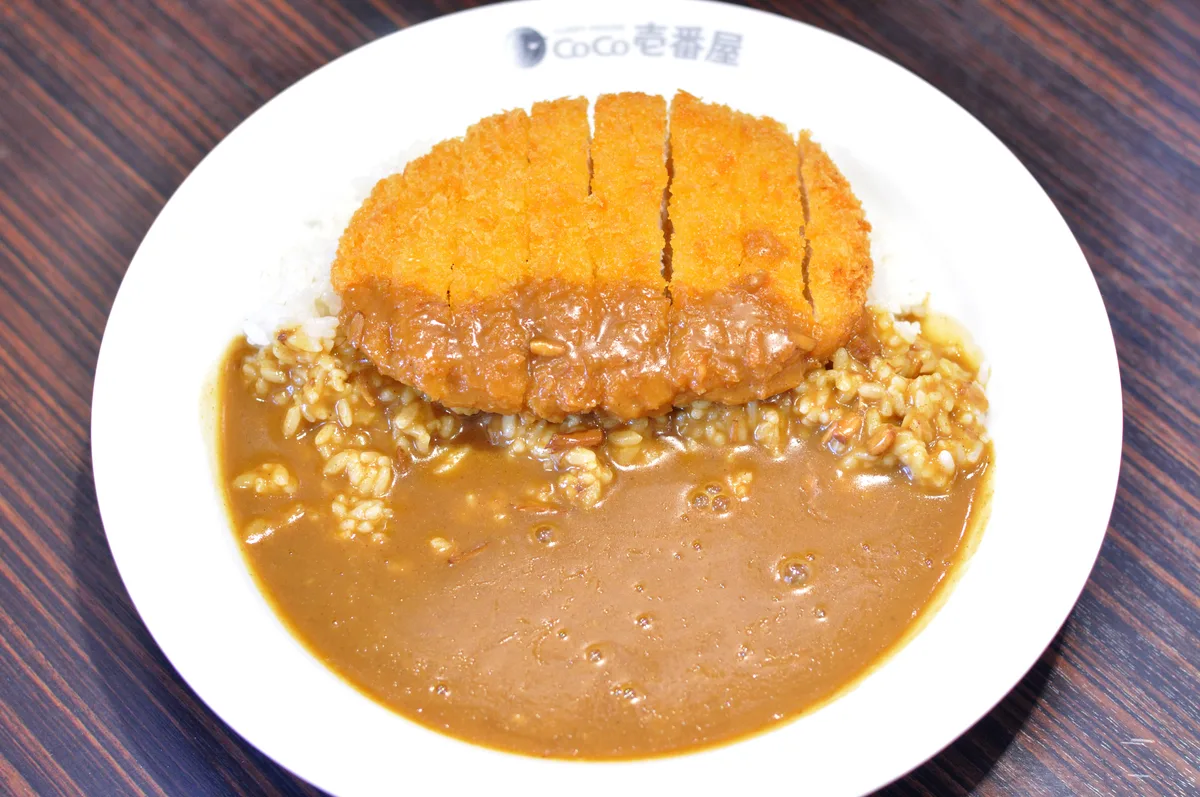
- Make the cutlet. Coat a pork loin steak or a flattened chicken breast in flour, then beaten egg, then panko breadcrumbs, and deep-fry until golden and cooked through. Rest it for a minute and slice it into strips.
- Serve. Spoon rice onto one side of a wide plate, lay the sliced cutlet against it and pour the curry alongside, with pickles if you have them.
Each brand’s box gives slightly different amounts, so House advises following the recipe on the pack you buy. Restaurant curry takes far longer: JETRO reports that Hiden in London cooks its curry for around 12 hours.
Where to Eat Japanese Katsu Curry in London
Prices and opening hours for Hiden and Kanazawa come from their own websites, checked on 2 November 2026. For the British version described above, any Wagamama branch serves it.
Hiden, Coal Drops Yard and Stroud Green Road
Hiden is a Japanese curry specialist that opened its curry lab at Coal Drops Yard in King’s Cross in 2020, during lockdown, and a kissaten-style café, modelled on Japan’s old-fashioned coffee shops, on Stroud Green Road in Finsbury Park in 2023. Chef Hiroki Uda makes the curry from scratch every day in King’s Cross, from recipes inherited from co-founder Hideaki Yoshiyama, with a beef sauce, a milder chicken sauce and a vegan red lentil sauce. A chicken katsu bowl with any sauce costs £15.70, or build your own from £11.90 for beef or chicken curry and add katsu for £3.80. Menus are on Hiden’s website, and our guide to the best Japanese restaurants in London picks Hiden for katsu curry.
King’s Cross: Unit 114, Lower Stable Street, Coal Drops Yard, London N1C 4DR. Monday to Saturday 11.30am to 8pm, Sunday 11.30am to 6pm. Nearest Tube: King’s Cross St Pancras.
Finsbury Park: 53 Stroud Green Road, London N4 3EF. Closed Monday; Tuesday 11am to 5pm; Wednesday to Friday 11am to 9.30pm; Saturday 10.30am to 9.30pm; Sunday 10.30am to 5pm. Nearest Tube: Finsbury Park.
Map of Hiden Japanese Curry Lab
Japan Centre Westfield London, Shepherd’s Bush
Japan Centre’s food hall in Westfield London, which the company describes as Europe’s largest Japanese food hall, cooks katsu curry in its open kitchens alongside sushi, ramen and takoyaki. It sits in Relay Square on the ground floor, a short walk from Wood Lane and Shepherd’s Bush stations, and opens Monday to Thursday 9.30am to 9.30pm and Friday and Saturday 9am to 9.30pm.
Kanazawa Curry Bread, Islington Green
Japanese curry also comes wrapped in dough. Kanazawa, a Japanese-owned bakery on Islington Green, specialises in curry bread: Japanese curry in a piece of dough, coated and deep-fried. From April to December it also runs a stall from Thursday to Sunday at Lower Stable Street Market, on the same street as Hiden’s curry lab. Our guide to Japanese bakeries in London has more places to buy curry pan, as curry bread is called in Japan. Details are on Kanazawa’s website.
Address: Unit 3, 34 Islington Green, London N1 8DU. Tuesday to Sunday 10am to 4pm. Nearest Tube: Angel.
CoCo Ichibanya, Japan’s largest curry chain, opened its first London restaurant on Great Newport Street in 2018 and announced a second on James Street in Marylebone for 2020. We could not confirm that either branch is trading in November 2026, so neither is listed here.
Katsu Curry: Questions and Answers
Katsu curry is a Japanese dish of a breaded, deep-fried cutlet served with rice and Japanese curry sauce. Katsu means cutlet, and in Japan the cutlet is usually pork; in the UK it is usually chicken. The best-known account of its invention places it at Ginza Swiss, a Tokyo restaurant, in 1948.
Yes. Katsu curry was created in Japan, although both halves have Western roots: curry reached Japan from Britain in the Meiji era, and the breaded cutlet came from European cooking. The best-known claim to the first katsu curry is Ginza Swiss in Tokyo in 1948. The chicken version with a sweet sauce is the form that became popular in Britain through Wagamama.
Katsu is short for katsuretsu, the Japanese way of saying cutlet, and in Japan it means a breaded, deep-fried cutlet of meat. Tonkatsu is a pork cutlet and chicken katsu is a chicken one. In British shops the word is often used for the curry sauce alone, a habit Japanese social media users questioned under the hashtag #KatsuCurryPolice in 2020.
In Japan the sauce is ordinary Japanese curry: meat, onion, carrot and potato simmered in water, then thickened with a roux block of flour, fat and curry spices. House Foods’ home method simmers the vegetables for about 15 minutes, dissolves the roux off the heat and simmers for 10 minutes more. Sauces sold in Britain as katsu sauce are usually sweet and curry-flavoured.
Nobody can say for certain. Ginza Swiss in Tokyo says it first served a pork cutlet on curry rice in 1948, for the Yomiuri Giants baseball player Chiba Shigeru, and that is the best-known claim. Kawakin in Asakusa dates a similar dish to 1918 and Ōroji in Shinjuku to 1921. Ginza Swiss’s owner has said that no one has any proof.
Japanese curry, or karē raisu, is a thick curry stew of meat and vegetables served with rice. Katsu curry is the same plate with a breaded cutlet added. In the UK, katsu curry often means the sweet curry sauce itself, so a British katsu curry sauce may come with no cutlet at all.
Hiden, a Japanese curry specialist, makes its curry from scratch every day at Coal Drops Yard in King’s Cross and also runs a café on Stroud Green Road in Finsbury Park; a chicken katsu bowl costs £15.70. Japan Centre’s food hall in Westfield London cooks katsu curry in its open kitchens, and Wagamama serves the British version across the city.