I’d never been invited to a tea ceremony before. And in fact I checked with both my Japanese friends and friends who have lived in Japan, and only a smattering of them had been to one either. The tea ceremony is an iconic pillar of Japanese culture, a tradition known the world over. I knew that it was a kind of formal tea-drinking event, whereby one expert server makes tea for a number of guests, in a formal environment full of movement, action and decorum. But recognising it and taking part in it are two very different things.
So when artist Molly Maine invited me to attend a private tea-ceremony event as part of her NOMAD: Perspectives on Home in a Changing Japan exhibition, I was totally intrigued. With its earliest form dating back to the 9th Century the Japanese tea ceremony is a link to the past, exclusive and special. What a great opportunity, I’d love to go. It was time for me to experience the real thing.
Having spent last Thursday evening perusing Molly’s gallery, admiring her artwork but also learning more about the deeper meaning and stories behind it, the tea ceremony was taking place in a friendly context. It felt good to be back as I walked in the door, surrounded by artwork and people I knew and responded to.
We took our seats and were introduced to Iccho Hama, an architect and calligrapher who had travelled from Japan to be part of the exhibition. Her traditional attire underscored how important style was to the event, and I felt mildly underdressed in my simple red jumper. Alongside me were five other guests and Molly Maine herself. We chatted away, each of us from some kind of different discipline, a writer, an artist, a therapist, a publisher, all ready and eager to participate in the ceremony together.

Iccho began by cleaning the implements she would be using, 6 cups set aside for us, a small wooden ladle to move tea, the traditional bamboo matcha whisk, a bowel for cleaning, one bright red serviette and most importantly of all, the fresh floral matcha straight from Kyoto. Alongside a thoroughly modern, plastic practical kettle, which I think added an amusing contrast.
Matcha tea is fairly straightforward ingredients wise, the green dried tea is simply mixed with hot water. But the process of the tea ceremony is absolutely one of those “easy to learn, hard to master” systems. Iccho demonstrated. Pouring some hot water into the waiting cup so as to heat it, pouring it out, adding a measure of matcha powder into the cup with the ladle, pouring boiled water in, before vigorously whisking it together to create the rich, mildly foamy drink. Then the cup is passed to the waiting guest with the “best”, smoothest side of the cup facing them, for maximum aesthetic enjoyment. Implements are then cleaned with the serviette before Iccho moves on to the next cup.
I may have got the order wrong, or missed an action out, which should underscore how precise and methodical the entire system is. A work of art in itself.
We chatted and laughed, how much caffeine was there in matcha anyway? Would we all be up late into the night now? Surely if so it would be worth it!

Alongside our tea we were given small sugar sweets, traditionally taken together- mixing the sweet and bitter to enhance the flavour of both. Iccho reminded us that today was Tanabata the “evening of the seventh”, a Japanese festival which celebrates the tale of two star-crossed (quite literally) lovers, who are only permitted to cross the universe to visit each other on the seventh day of the seventh month. The sweets we were given were two half circles, forming a whole when put together. I’d completely forgotten, but here we all were. What serendipity.
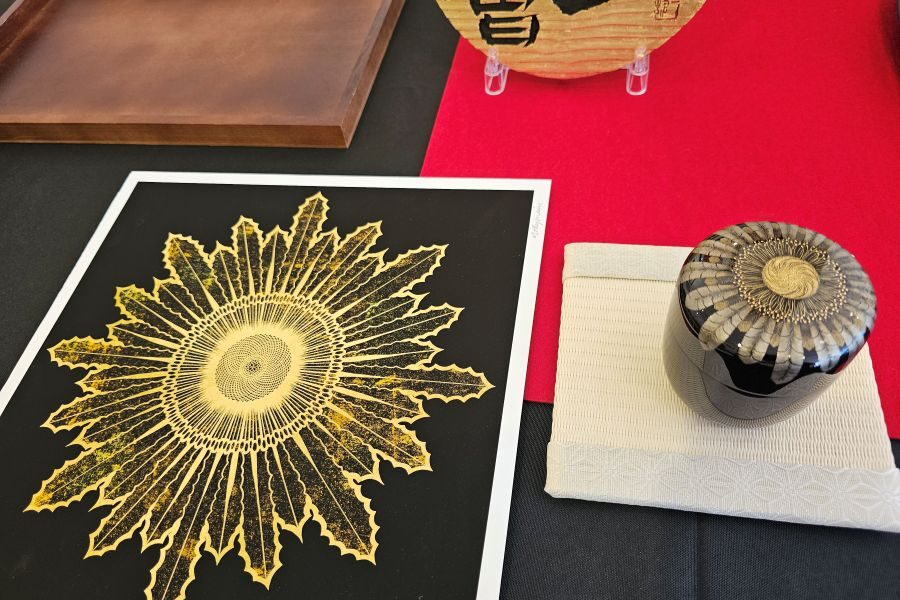
We admired up close an art piece Molly had created with a Noto artist Yu Yamagishi. A black and gold lacquered matcha tea pot, similar to the one Iccho was using during the ceremony. Molly and Yu had created it together to commemorate and rebuild after the Noto earthquake of January 2024. Seeing the texture and detail up close was quite enchanting.
The tea was good: refreshing and invigorating. Drinking matcha really does feel like you’re doing yourself good. In a way that necking a quick espresso or a sugary frappuccino really doesn’t. I could get into the habit of this.
As the evening drew to a close we said our goodbyes, though not before enjoying a second cup, and gave our deep thanks to Iccho for hosting us and Molly for arranging the evening. It’s strange how after only visiting it twice the gallery now feels very quite homely. And with this tea ceremony evening it’s an experience we’ll all truly remember, even as we part ways for now.
NOMAD: Perspectives on Home in a Changing Japan is showing at the 67 York Street Gallery in Marylebone 4th July – 13th July 2025